


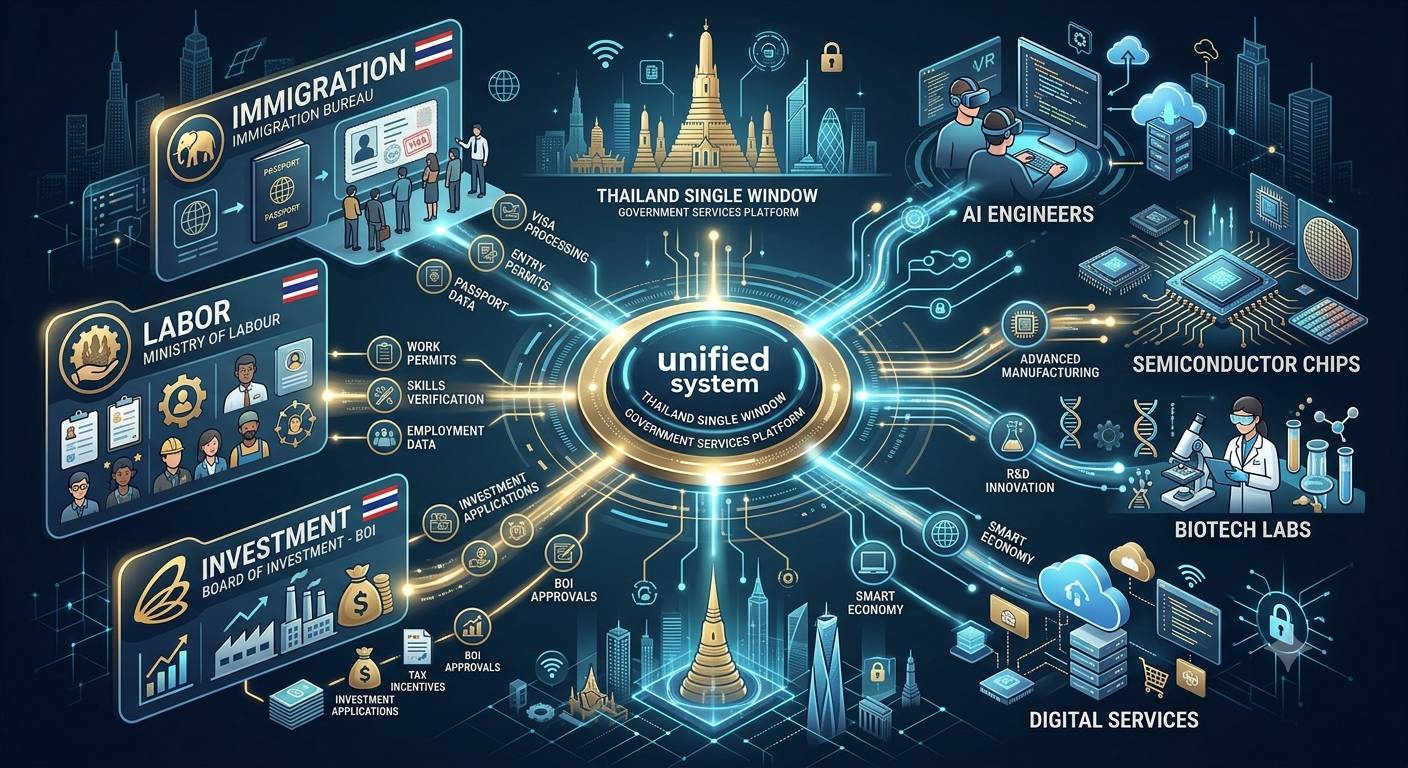
Thailand is rapidly transforming its investment and immigration ecosystem through the integration of Digital Work Permits (D-WP) under the BOI Single Window system. The reform reflects the government’s broader strategy to position Thailand as a regional innovation and investment hub for advanced industries, particularly in sectors such as Artificial Intelligence, semiconductors, digital services, biotechnology, and smart manufacturing.
For BOI-promoted companies, the traditional administrative burden associated with foreign workforce management is being fundamentally redesigned. Physical work permits are gradually becoming obsolete as the Board of Investment (BOI), Immigration Bureau, and Ministry of Labor move toward a centralized digital compliance platform. The result is not merely administrative convenience, but a structural shift in how multinational businesses deploy global talent into Thailand.
The Transition from Physical Work Permits to a Digital Compliance Ecosystem
Historically, foreign employee onboarding in Thailand involved fragmented coordination between multiple government agencies. Companies were required to separately manage visa applications, work permit approvals, employment ratio requirements, and immigration reporting obligations. This process often created operational delays for regional headquarters and high-technology projects requiring rapid specialist deployment.
The BOI’s Single Window Integration changes this framework by consolidating immigration and labor authorization into a unified digital platform. Through the D-WP system, approved foreign employees can now access digital work authorization directly via a mobile application connected to government databases.
This integration significantly reduces duplication of documentation and improves regulatory visibility for authorities. More importantly, it allows BOI-promoted businesses to accelerate the mobility of highly skilled personnel, particularly for project-based operations involving engineers, AI specialists, semiconductor experts, data scientists, and regional executives.
The digitalization initiative also aligns Thailand with broader global trends in smart governance, where immigration compliance increasingly operates through real-time digital verification rather than paper-based authorization systems.
Strategic Linkage with LTR and Smart Visa Programs
A critical aspect of the D-WP reform is its direct connection with Thailand’s Long-Term Resident (LTR) Visa and Smart Visa frameworks. These programs were specifically designed to attract high-value foreign talent, investors, researchers, and executives into strategic industries prioritized under Thailand’s economic transformation agenda.
Under the integrated system, BOI-promoted companies benefit from substantially greater flexibility in employing foreign specialists compared to non-promoted entities. One of the most commercially significant advantages is the exemption from the traditional “four Thai employees to one foreign employee” ratio requirement, which has historically constrained workforce planning for knowledge-intensive industries.
This exemption is particularly important for companies operating in sectors where technical expertise cannot easily be localized in the short term. Semiconductor fabrication facilities, AI development centers, advanced robotics operations, and digital infrastructure projects often require highly specialized foreign personnel during initial investment and technology transfer phases.
The government’s policy direction indicates a deliberate shift away from quantity-based labor controls toward competency-based immigration assessment. Thailand is effectively prioritizing strategic skill inflows that contribute to national competitiveness, innovation capacity, and advanced industrial development.
Enhanced Regulatory Oversight and Data Transparency
While the D-WP system simplifies workforce administration, it simultaneously increases regulatory scrutiny and data transparency. The integration between BOI, Immigration, and labor authorities allows agencies to monitor employment structures, visa status, project activities, and foreign workforce movements more efficiently.
For multinational corporations, this means immigration compliance is becoming increasingly data driven. Authorities now possess stronger capabilities to cross-check project implementation timelines, employee roles, tax registrations, and operational substance against BOI promotion conditions.
As a result, companies can no longer treat work permit compliance as a purely administrative function. Workforce mobility strategies must now align closely with investment promotion commitments, technology transfer obligations, and operational substance requirements.
Businesses utilizing BOI privileges should therefore establish stronger internal governance over foreign employee deployment, including role justification, project allocation records, intercompany secondment arrangements, and digital compliance monitoring. Failure to maintain consistency across government reporting systems may trigger increased regulatory review during BOI audits or visa renewal processes.
Thailand’s Emerging Position as a Regional Talent and Innovation Hub

The modernization of Thailand’s immigration and work authorization framework reflects a broader economic objective: attracting high-value investment while competing regionally for global talent.
Countries across Asia are aggressively introducing specialized visa programs and digitalized immigration systems to attract technology-driven investment. Thailand’s advantage lies in combining BOI tax incentives, digital workforce administration, infrastructure investment, and targeted visa programs into an integrated investment platform.
For international businesses, the practical impact is substantial. Faster deployment of foreign specialists reduces project implementation delays, improves regional management flexibility, and enhances Thailand’s attractiveness as a headquarters location for ASEAN operations.
However, the reform also signals that Thailand expects greater economic substance from foreign-invested businesses. Incentive access is increasingly tied to measurable contributions such as advanced technology adoption, research and development activities, local workforce upskilling, and strategic industrial participation.
The D-WP Single Window Integration therefore represents more than a digital immigration reform. It is part of Thailand’s broader transition toward a technology-focused investment environment where regulatory facilitation and stricter strategic oversight operate simultaneously. Companies that understand this dual direction will be better positioned to maximize BOI privileges while maintaining long-term regulatory stability in Thailand’s evolving investment landscape.
