

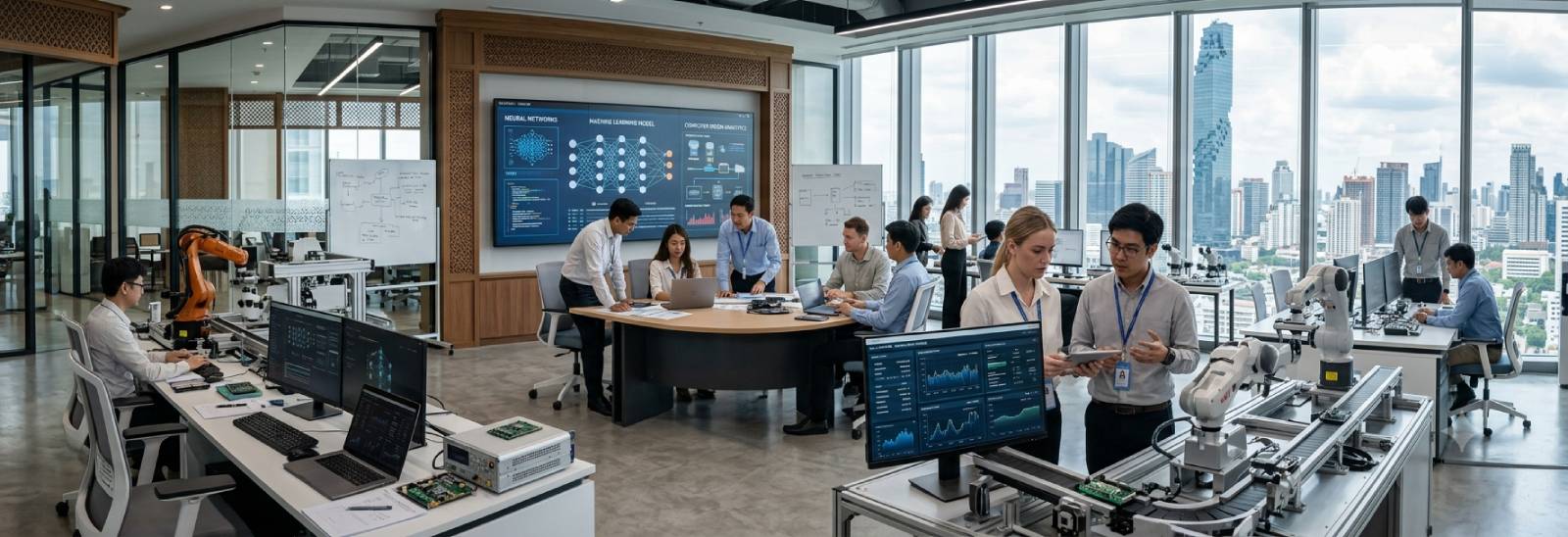
Thailand’s Board of Investment (BOI) is fundamentally changing the way it evaluates technology investment projects in 2026. While the country continues offering some of ASEAN’s most aggressive tax incentives for advanced industries, the approval process has become significantly more selective — particularly for companies seeking prestigious Group A1 privileges.
Under the updated BOI framework, qualifying Artificial Intelligence projects can receive an uncapped 8-year corporate income tax exemption, import duty exemptions, and additional merit-based tax reductions that may extend incentives up to 13 years. AI-related software development, advanced robotics, embedded systems, and R&D centers are now positioned among Thailand’s highest-priority strategic sectors.
However, the BOI is no longer rewarding companies merely for “using AI.” The agency is increasingly focused on whether applicants are genuinely creating proprietary technological capability inside Thailand.
This marks a major shift from incentive-driven investment promotion toward capability-driven industrial policy.
Thailand Is Moving Beyond “Digital Adoption” Toward Proprietary Innovation

For years, many companies entering Southeast Asia described relatively standard software deployment projects as “digital transformation” or “AI innovation.” In practice, numerous projects involved little more than integrating imported enterprise software, automation platforms, or commercially available analytics tools into local operations.
Thailand’s BOI appears determined to close that gap.
In 2026, BOI technical interviews and project evaluations have become substantially more rigorous for applicants seeking Group A1 classification. The agency increasingly distinguishes between companies that merely consume AI technology and those that actively develop or localize advanced AI capability within Thailand.
The difference is critical.
A factory implementing a generic warehouse automation platform may no longer qualify as a strategic AI project. By contrast, a manufacturer developing machine-learning systems for predictive robotics calibration, computer vision quality inspection, semiconductor process optimization, or industrial digital twins is viewed far more favorably.
The BOI’s evaluation focus now extends into highly technical areas such as:
- Proprietary algorithm development
- Local R&D engineering capability
- AI model training and optimization
- Industrial deployment complexity
- Integration with advanced manufacturing systems
- Technology transfer to Thai personnel
This aligns with Thailand’s broader effort to transition from a technology-import economy into a regional innovation and engineering hub. AI is no longer treated as a supporting digital tool; it is increasingly viewed as strategic national infrastructure.
“Tech Transfer” Has Become a Core Investment Evaluation Metric
One of the most significant developments in Thailand’s 2026 investment strategy is the elevation of technology transfer from a secondary compliance topic into a central approval criterion.
Historically, multinational firms could often secure incentives based primarily on capital expenditure, export value, or industrial category alignment. Today, the BOI increasingly asks a deeper question: what technological capability will remain in Thailand after the investment is operational?
This is where the concept of “Applied AI” becomes especially important.
Thailand’s government wants foreign investment projects that generate long-term domestic capability accumulation rather than projects that remain permanently dependent on imported software vendors or expatriate engineering teams.
As a result, applicants are increasingly expected to demonstrate:
- Internal AI engineering functions in Thailand
- Thai participation in model development and deployment
- Knowledge transfer programs for local engineers
- Local R&D or testing laboratories
- Collaboration with Thai universities or research institutes
- Scalable intellectual property development capability
The policy objective is strategic rather than symbolic. Thailand recognizes that future competitiveness in advanced manufacturing, semiconductors, robotics, and digital infrastructure will depend heavily on domestic technical depth.
Without active technology transfer, even high-value foreign investment may contribute relatively little to long-term national competitiveness.
This explains why BOI interviews in 2026 reportedly place greater emphasis on technical substance rather than presentation language. Companies must increasingly prove that their AI architecture, deployment methodology, and engineering workflows involve real innovation activity rather than outsourced implementation models.
The Industrial AI Sectors Receiving the Strongest Attention

Thailand’s BOI is not prioritizing all AI applications equally. The strongest support appears concentrated in sectors capable of strengthening industrial productivity, export competitiveness, and advanced manufacturing ecosystems.
Industrial AI applications receiving significant strategic attention include:
- Machine learning for robotics and automation
- Computer vision for defect detection and quality control
- Predictive maintenance systems for smart factories
- AI-driven semiconductor process optimization
- Embedded AI for IoT and edge devices
- Advanced manufacturing analytics platforms
- AI-assisted logistics and industrial planning systems
These areas align closely with Thailand’s broader industrial ambitions in EV production, semiconductor ecosystems, smart electronics, and Industry 4.0 manufacturing transformation.
Importantly, the BOI is increasingly evaluating whether AI projects generate “high-value technical spillover” into the local economy. A company operating a standard SaaS deployment may struggle to justify A1 treatment, while a project involving local AI model development, industrial algorithm refinement, or Thai-based engineering teams may receive substantially stronger consideration.
This reflects a global trend in industrial policy. Governments worldwide are becoming more selective about which forms of technology investment qualify for premium incentives.
The era when every software project could claim “innovation” status is rapidly disappearing.
Thailand’s AI Incentive Strategy Is Ultimately About Economic Positioning
Thailand’s AI-focused BOI reforms are not merely tax policy adjustments. They represent an attempt to reposition the country within the global technology value chain.
The government understands that Southeast Asia is entering a new competitive phase where attracting capital alone is insufficient. Countries are now competing for strategic technological ecosystems, engineering talent, intellectual property generation, and AI-driven industrial capability.
Thailand’s response is increasingly sophisticated: offer globally competitive incentives but tie them to measurable innovation depth and domestic capability development.
This is why Group A1 incentives remain exceptionally generous while scrutiny simultaneously becomes more demanding. The government is effectively signaling that it welcomes advanced AI investment — but only where companies contribute genuine technological value creation inside Thailand.
For multinational companies, the implication is clear. Successful BOI applications in 2026 will require more than polished pitch decks or generic digital transformation language. Investors must demonstrate authentic technical differentiation, scalable R&D structures, and credible long-term technology transfer strategies.
In the years ahead, Thailand’s industrial policy may increasingly reward not the companies that simply deploy technology in the country, but those that actively help Thailand build technological sovereignty of its own.
