


Thailand’s Land and Building Tax (LBT) regime has entered a new phase. The temporary relief measures and transitional tax reductions that accompanied the implementation of the Land and Building Tax Act B.E. 2562 (2019) have largely concluded, placing property owners, developers, and investors under heightened scrutiny. At the same time, local authorities, particularly the Bangkok Metropolitan Administration (BMA), have significantly enhanced their assessment capabilities through the use of satellite imagery, geospatial mapping technologies, and artificial intelligence-driven land-use analysis.
The fundamental principle of the LBT framework is that tax liability depends not merely on ownership but on the actual utilization of land. Agricultural land receives preferential treatment, residential land enjoys varying levels of relief, while vacant or underutilized land attracts the most punitive tax treatment. The law was intentionally designed to discourage long-term land speculation and encourage productive land use. Under current regulations, vacant land is subject to progressively increasing tax rates, with additional surcharges imposed for land that remains unused over extended periods.
For owners of strategic land banks in prime Bangkok locations such as Sukhumvit, Sathorn, Rama IX, and Phahon Yothin, the financial consequences of land classification can be substantial. A single reassessment from agricultural or productive use to vacant land status can materially alter annual holding costs and investment returns.
How AI and Satellite Technology Are Transforming Land Classification
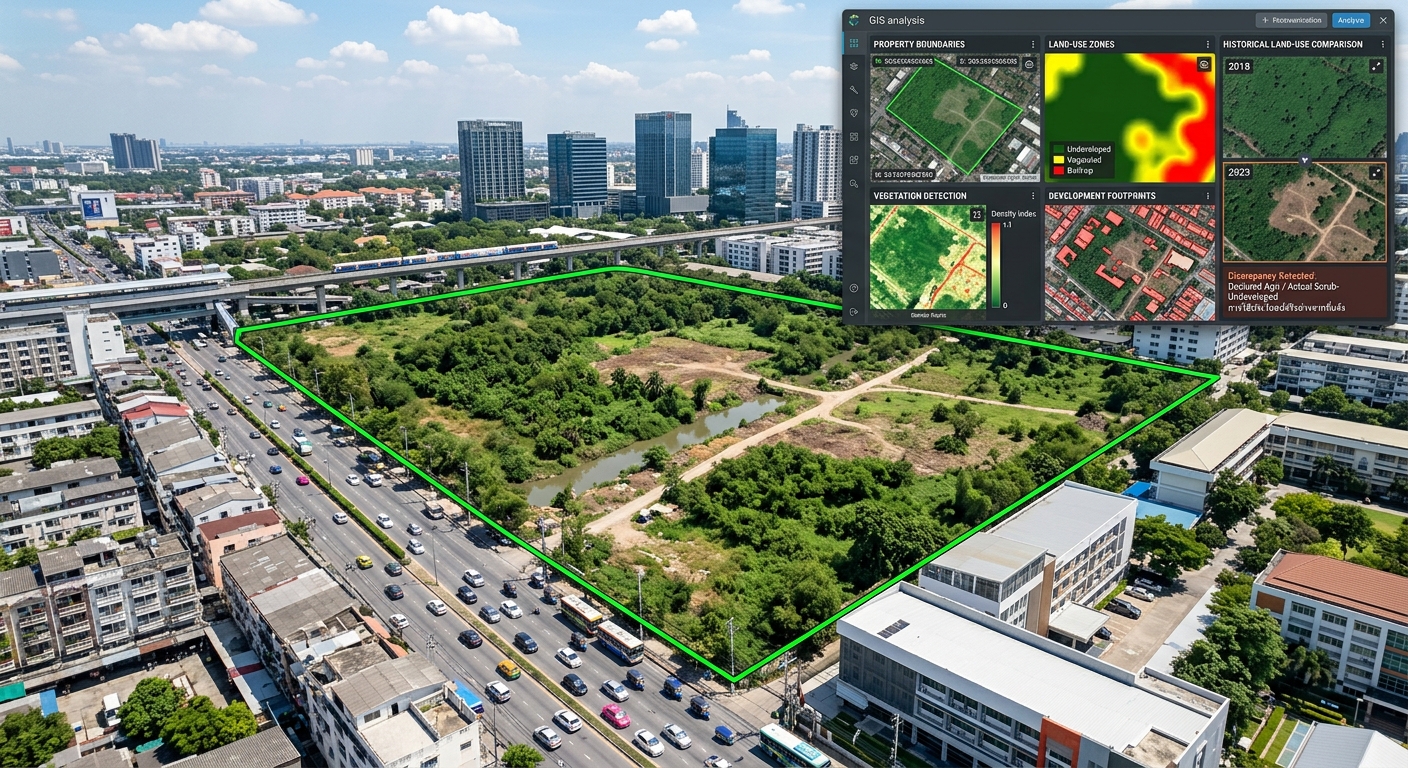
Historically, local authorities relied heavily on physical inspections, owner declarations, and municipal records to determine land-use classifications. Today, advancements in remote sensing technologies have dramatically changed the assessment landscape.
Modern land administration systems increasingly utilize satellite imagery, aerial photography, machine learning models, and geospatial analytics to identify patterns of land utilization. These technologies can detect vegetation coverage, building footprints, infrastructure development, access roads, drainage systems, and changes in land conditions over time. As a result, authorities are better equipped to challenge classifications that appear inconsistent with actual land use.
For example, a vacant plot that was previously reported as agricultural land may now be reviewed against historical imagery and current satellite data. If authorities determine that agricultural activities are superficial, inactive, or inconsistent with prescribed standards, the property may be reclassified as vacant land, triggering substantially higher tax liabilities. The increasing use of technology has shifted tax disputes away from simple administrative reviews toward evidence-based assessments requiring technical, accounting, and legal expertise.
This evolution has created a growing demand for accountants, tax advisors, land valuation experts, and legal professionals capable of preparing defensible documentation that demonstrates genuine beneficial use of land.
The Strategic Role of Accountants in Land Classification Disputes
In sophisticated property groups, accountants are no longer merely responsible for recording annual tax expenses. They have become central participants in land-use planning and tax-risk management.
When developers acquire land for future projects, it is common for significant periods to pass between acquisition and construction. During this holding period, the tax classification of the land becomes critically important. Accountants must work alongside project managers, engineers, and legal advisors to document activities that support productive use classifications while remaining compliant with applicable regulations.
This often involves maintaining detailed records of site improvements, infrastructure preparation, environmental management activities, temporary structures, agricultural operations, maintenance contracts, utility installations, and development planning expenditures. The objective is not to artificially manipulate tax outcomes but to ensure that the economic reality of the property is accurately reflected in tax assessments.
The challenge has intensified following recent government attention toward aggressive agricultural-tax planning structures. Authorities have become increasingly focused on determining whether agricultural activities represent genuine economic use or merely cosmetic arrangements intended to obtain preferential tax treatment. Consequently, documentation quality, accounting records, operational evidence, and consistency between financial statements and land-use claims have become essential factors in defending tax positions.
Advanced Tax Planning Considerations for Land Banks and Developers

For major developers and real estate investment groups, Land and Building Tax has evolved from a relatively minor compliance issue into a significant asset-management consideration. Large undeveloped land banks can generate substantial recurring tax costs if classified as vacant land, particularly as progressive increases accumulate over time.
Forward-thinking organizations therefore integrate LBT considerations into acquisition strategies, development timelines, feasibility studies, and financial modelling. Tax planning increasingly involves evaluating the timing of construction activities, interim land-use strategies, mixed-use classifications, and the evidentiary requirements necessary to support productive-use claims.
Moreover, recent amendments concerning multi-purpose property usage have introduced additional complexity in determining how different portions of land and buildings should be assessed. This requires careful allocation methodologies, valuation analyses, and supporting documentation to ensure that assessments accurately reflect the property's actual utilization.
As Thailand continues its digital transformation of tax administration, disputes over land classification are likely to become more technical, data-driven, and evidence-based. In this environment, successful tax management depends not only on legal ownership but on the ability to substantiate the true economic use of land through comprehensive accounting records, operational documentation, and strategic compliance planning.
For property developers, family offices, and institutional investors holding significant land assets, Land and Building Tax is no longer simply an annual local tax. It has become a critical component of long-term asset management, investment performance, and regulatory risk control in Thailand’s increasingly sophisticated property taxation landscape.
