
A Bangkok design company signs a contract with a Singapore customer, collects a deposit for a Thai project and pays an overseas software supplier in the same week. One bank statement may show the deposit and the software payment, but it cannot show where the customer uses the design work. Each raises a different VAT question. Who receives the service? Where is it used? Which event belongs in this month's return? A bank statement cannot answer those questions on its own.
Use this guide to make three decisions before filing. Establish whether the Thai operation needs to register, work out how each type of sale or purchase should enter the records, and build a file from which another person can reproduce the amount payable. The worked examples use fictional companies, transactions and amounts in Thai baht. The suggested checks are office procedures. The linked authorities identify the legal rules.
Decide when registration becomes a live issue
For a business regularly supplying taxable goods or services in Thailand, the Revenue Department gives an annual turnover threshold of THB 1.8 million and a registration period of 30 days after taxable turnover exceeds that threshold. Some activities are exempt. Import VAT and certain overseas-service payments have their own rules. First identify the legal entity making the supply, what it sells and which receipts enter its taxable turnover. A capital contribution and a customer payment can look identical in an export from online banking. Their underlying documents tell you which is which. Revenue Department registration guidance
Consider a founder whose business has recorded THB 1.74 million in qualifying turnover. A further THB 90,000 qualifying sale would bring it to THB 1.83 million. The question for the accountant is the date on which that transaction counts under the applicable rules. The date the founder notices the balance has crossed the threshold can be much later. Keep an event log with the supply, customer, amount, relevant date, supporting document and running total. Give the person closing the sales ledger responsibility for alerting the director before a large sale takes the business across the threshold.
For a Bangkok registration, identify the responsible Area Revenue Office, check the current P.P.01 application and prepare evidence for the actual premises. Gather the company registration details, signing authority and documents connecting the company to its address. The supporting documents can differ for a rented office, owned premises and a representative filing for the company. Ask the responsible office for its current list before arranging signatures. Record the application date, the effective registration date and the details on the P.P.20 certificate separately. Check the registered entity, address and branch against the invoicing system before issuing the first VAT invoice. Revenue Department registration and certificate provisions
Agree the price and tax treatment before invoicing
As at this guide's review date, the general reduced rate is 7% including local tax through 30 September 2027. Royal Decree No. 807 is the enacted instrument. The Cabinet announcement explains the policy and is an earlier step in the process. Put the end date in the accounting system's tax-rate review calendar. A contract spanning that date should say how the parties handle a statutory change. Royal Decree No. 807 · Royal Thai Government announcement
Suppose a sales manager quotes THB 214,000. If that is the agreed VAT-inclusive price at 7%, the net sale is THB 200,000 and the output VAT is THB 14,000. If the parties agreed on THB 214,000 plus VAT, the customer owes THB 228,980. The wording changes the commercial result by THB 14,980. Keep the signed quotation next to the invoice and show the approved net price, rate, tax and gross price in separate accounting fields. If a customer disputes the total, the account manager can resolve the price question before the accountant adjusts any tax record.
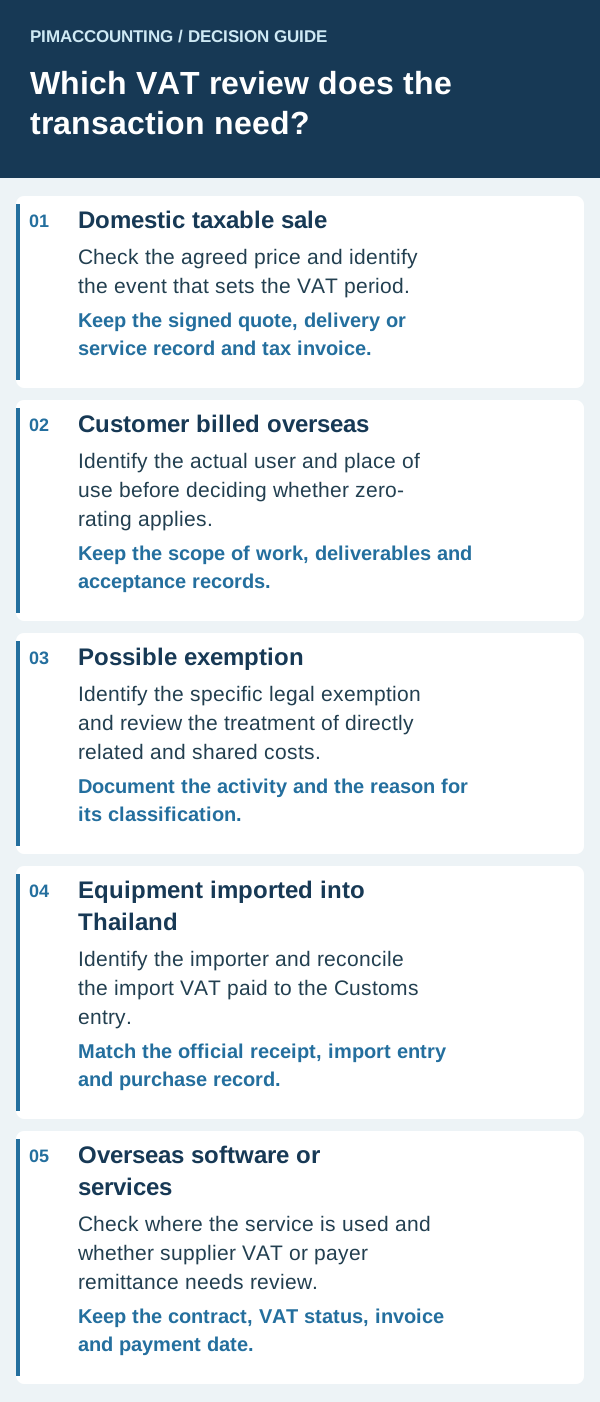
| Transaction | Question to settle | Evidence to retain |
|---|---|---|
| Local sale at the general rate | What price was agreed and when did the tax point arise? | Signed order, delivery or service record, tax invoice and payment references |
| Service billed to an overseas customer | Where was the service used, by whom, and do the conditions for zero-rating apply? | Contract, scope of work, deliverables, acceptance and evidence of actual use |
| Potentially exempt activity | Which legal exemption covers this specific supply? | Description of the activity, applicable provision and treatment of related purchases |
| Imported equipment | Who is named as importer and who paid the import VAT? | Customs entry, official receipt and purchase record |
| Overseas software or advice | Who supplied the service, where was it used, and what is the customer's VAT status? | Supplier terms, billing profile, invoice, payment and remittance analysis |
A zero-rated sale and an exempt sale can both produce a customer invoice with no output VAT. Eligible input tax linked to zero-rated activity can generally be recovered. Input VAT attributable to exempt activity is generally excluded. If the Bangkok company supplies both taxable and exempt activities, identify costs directly attributable to each and review the treatment of shared costs. A single tax code for all revenue invoiced in foreign currency conceals precisely this distinction. Revenue Code sections 80/1, 81 and 82/6
Put transactions in the correct month
Start with what the company supplied. The Revenue Code sets different tax-point rules for goods and services, with specific rules for arrangements such as instalment sales. Delivery, transfer, payment, use of a service or issue of a tax invoice can matter, depending on the transaction. Ask the accounting team to record the relevant events separately when they fall on different dates. Revenue Code sections 78–78/3
Imagine that a client pays an advance in late November for work due in December. Give the reviewer the contract clause explaining whether the amount is consideration for services or a genuinely returnable security deposit, the bank date, and any invoice already issued. If an advance is payment for a service that triggers VAT, the applicable amount may belong in November. Calling a receipt a “deposit” in the bank description does not settle its contractual character. If a later milestone invoice includes the same advance, link the two documents and show the amount already accounted for. Otherwise a single payment can enter output VAT twice.
For goods dispatched near month-end, list the dispatch date, delivery evidence, invoice date and any earlier payment or transfer. Have operations resolve missing proof of delivery while the shipment is still traceable. Keep a short note of the tax point chosen and the reason. That note is particularly valuable when the financial reporting period for revenue differs from the VAT period.
Check purchase evidence before releasing input VAT
Ask the buyer to obtain a full tax invoice addressed to the correct entity wherever input credit is expected. Check the issuer, buyer, required identification and branch particulars, serial number, date, description, taxable amount and separately identified tax. Retain the document in a form that preserves its origin. Staff should send discrepancies back to the supplier for correction. Changing a supplier's PDF internally destroys the distinction between the original record and a proposed correction. Revenue Code, tax invoice provisions · Pimaccounting on electronic invoice evidence
Build three purchase queues. In the first, a reviewer has matched a qualifying business purchase to sufficient evidence. In the second, evidence is missing or inconsistent and someone is responsible for obtaining it. The third contains items for which a restriction applies, such as certain entertainment expenditure. Only the first queue feeds the proposed credit for that return. Give each held item a supplier contact, next action and review date. A late replacement invoice requires a fresh check of the eligible claim period. Revenue Code sections 82/3 and 82/5
When a director pays personally for an office purchase, record who paid and who actually acquired the item. The expense reimbursement approval answers the first question. The contract or order and the supplier's documents help answer the second. An approved reimbursement may still leave an unresolved input VAT issue. Avoid posting the tax automatically when the employee is repaid.
Separate imported services from imported goods
For a service performed abroad and used in Thailand, examine whether the Thai payer must remit VAT using P.P.36. Identify the contracting supplier, where the work was carried out, where the result was used and when payment occurred. Review imported goods separately against the Customs entry. The commercial invoice for overseas equipment and the Customs receipt serve different purposes. Revenue Code section 83/6 and import provisions
For electronic services, the non-resident supplier regime specifically addresses supplies to customers in Thailand who are not VAT registered and has its own supplier threshold and conditions. If the Thai business registers after opening its software account, update the billing profile and keep the effective date. When the vendor charges an unexpected “tax” line, ask which jurisdiction and registration it relates to. Preserve the vendor's answer and have the accountant review the Thai remittance separately. This prevents paying or claiming an amount on the assumption that every line marked VAT has the same effect. Revenue Department electronic services guide · Pimaccounting on overseas software bills
For group companies, run this check on head-office recharges as well as external supplier payments. Obtain the underlying agreement, identify the service or goods received, and match the recharge period to the local operation. An intercompany journal can conceal a payment or settlement that an ordinary accounts-payable report misses. If the transaction also raises withholding tax or treaty questions, record these as separate decisions with their own evidence.
Work through a Bangkok company's month-end close
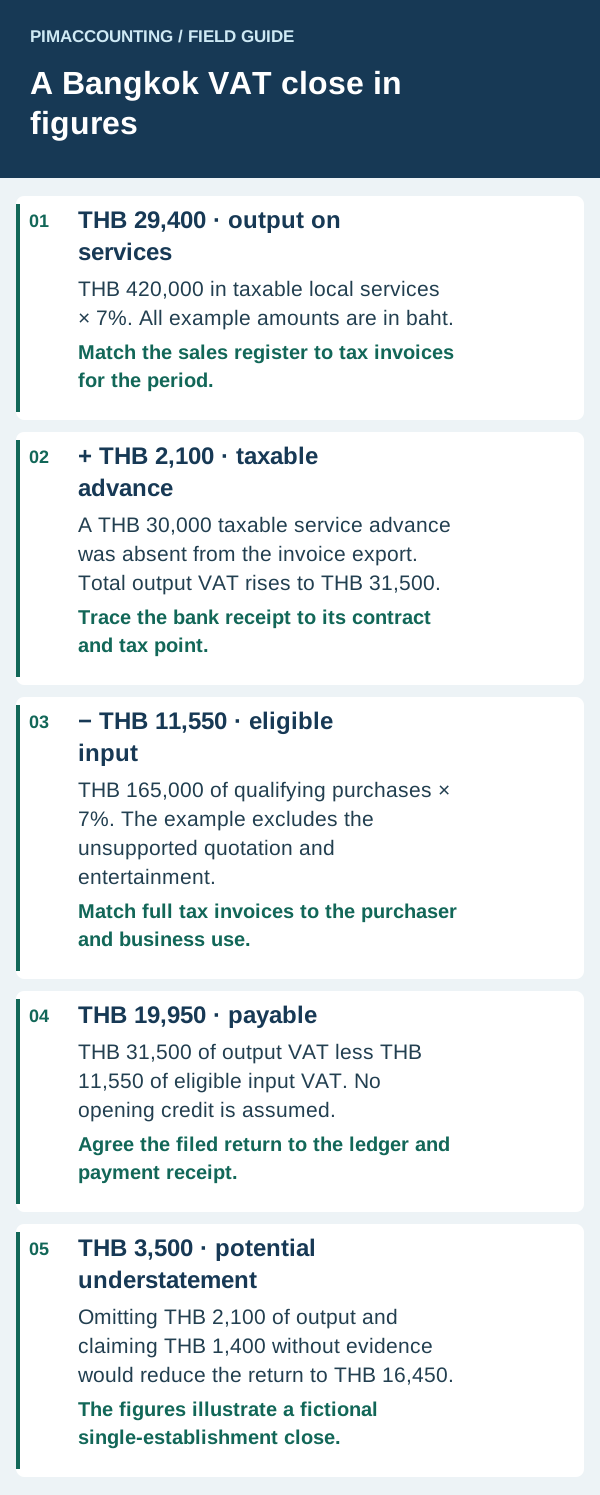
Assume a single registered Bangkok establishment makes only general-rate local sales in the example below. All listed sales tax points fall in the same month. The illustrations exclude credit carried forward, foreign exchange, withholding tax and P.P.36. A corrected purchase invoice, if later obtained, would need a separate eligibility and timing check.
| Item | Amount excluding VAT | VAT at 7% | Treatment in the example |
|---|---|---|---|
| Local service invoices | THB 420,000 | THB 29,400 | Output tax |
| Taxable service advance omitted from the invoice export | THB 30,000 | THB 2,100 | Additional output tax |
| Equipment and supplies with qualifying evidence | THB 165,000 | THB 11,550 | Eligible input tax |
| Purchase supported only by a quotation | THB 20,000 | THB 1,400 at issue | Hold the proposed credit |
| Restaurant entertainment for clients | THB 8,000 | THB 560 | Excluded on the stated facts |
The proposed return shows THB 31,500 of output VAT and THB 11,550 of eligible input VAT, giving THB 19,950 payable. Two common shortcuts would produce THB 16,450 instead. Omitting the advance removes THB 2,100 of output tax. Including the unsupported purchase adds THB 1,400 of credit. Together those errors understate the payment by THB 3,500. The arithmetic check is simple. Finding the missing bank receipt and identifying the quotation as insufficient are the substantive parts of the review. Revenue Code section 82/3
Now change one assumption. The THB 30,000 was a documented, fully refundable security deposit with no right to apply it against the service price at this stage. The accountant should reassess whether the assumed service payment occurred. If the review concludes that no tax point arose for it this month, output VAT in the example falls to THB 29,400 and the proposed payable becomes THB 17,850. Keep the contract and approval with the calculation. When the deposit is later returned, forfeited or applied to fees, reopen the analysis using that event.
Assign the monthly work and prove payment
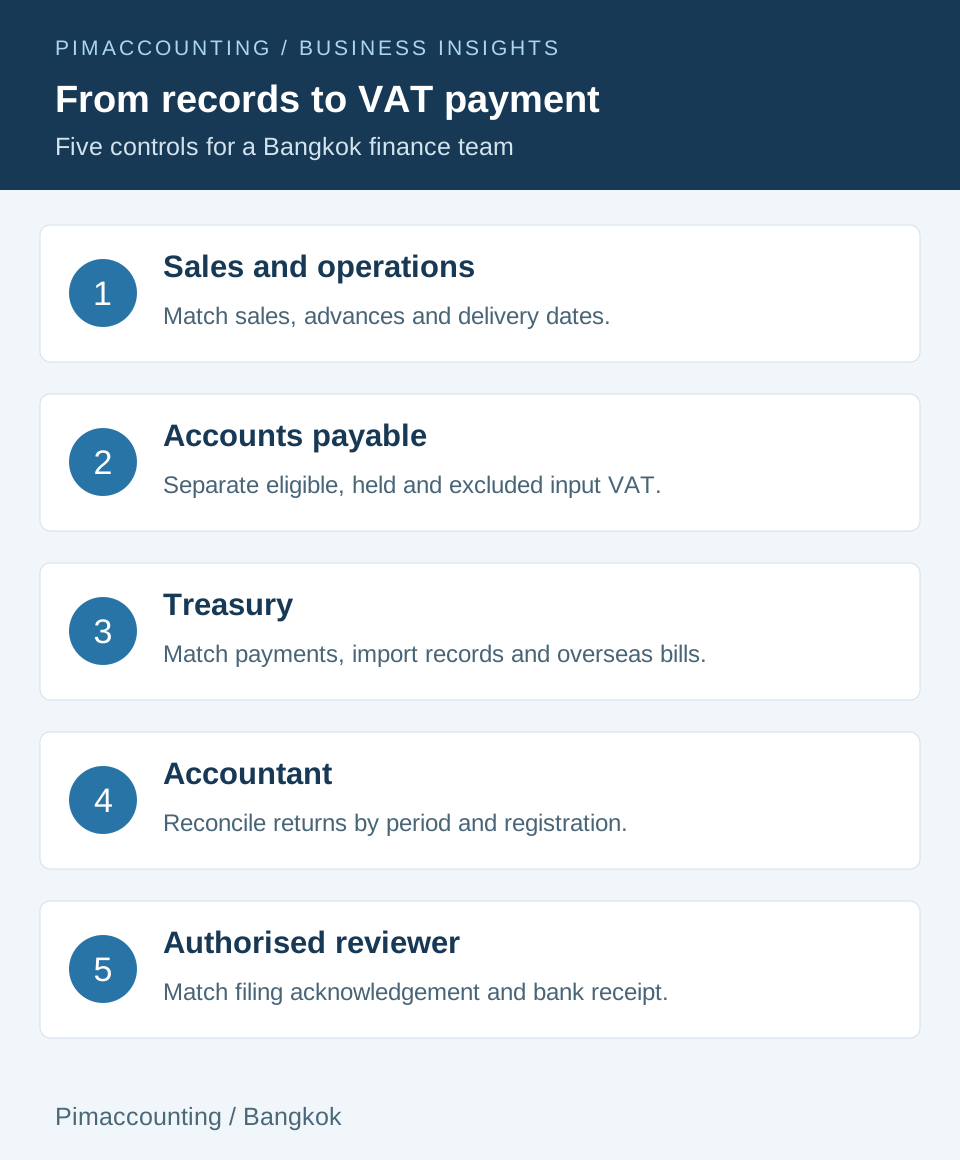
| Owner | Deliverable | What the reviewer checks |
|---|---|---|
| Sales and operations | Sales register, advances and deliveries near month-end | Missing numbers, cancelled documents, service use and receipts outside the invoice export |
| Accounts payable | Purchase register and list of held credits | Tax evidence, eligibility, duplicates and correct branch |
| Treasury | Imported-service payments, Customs receipts and bank matches | Payer, beneficiary, transaction date and reason for each unmatched item |
| Accountant | P.P.30 reconciliation by registration and P.P.36 review where relevant | Movement from the ledger to the return, opening credits and reviewer sign-off |
| Director or authorised reviewer | Filed return, acknowledgement and payment evidence | Correct period, account, amount, successful settlement and outstanding exceptions |
P.P.30 ordinarily covers a calendar month. The general filing rule is within the first 15 days of the following month. Check the current Revenue Department filing calendar for the specific month, filing channel, holiday treatment and any electronic extension before setting the payment date. A registered business still has monthly filing obligations in inactive periods. Multiple places of business generally file separately unless the Revenue Department has authorised combined filing. One company bank account is insufficient evidence of permission to combine branches. Revenue Department filing guidance · Revenue Code section 83
Before sign-off, reconcile the return to the ledger in both directions. Pick a sale from the ledger and trace it to the output register, then pick a line in the output register and trace it back to a real transaction. Do the same for input VAT, including a held item. Finally, compare the filed amount with the payment receipt and treasury record. A portal acknowledgement is evidence of submission. Keep the settlement confirmation as well so the next reviewer can establish whether the money actually moved.
Handle a credit balance, a mistake or an enquiry
If eligible input VAT exceeds output VAT, reconcile the difference before deciding whether to carry credit forward or request a refund. A capital purchase can explain a credit balance even in a healthy trading month. Prepare an opening-to-closing schedule and identify large purchases, zero-rated sales and amounts still under review. Have treasury distinguish a credit available for future use from cash expected in the bank. Revenue Code sections 84–84/3
If an error appears after filing, preserve the original return and the records on which the reviewer relied. Build a before-and-after calculation for each affected registration and period. Identify whether a supplementary return, payment, supplier correction or supporting document is required. Late or inaccurate filing can expose the business to penalties or surcharge. The amount depends on the specific failure and applicable provisions. Record the correction, the responsible person and any official response together. Revenue Code sections 83/4 and 89–89/2
For an enquiry, index each request separately. A request about one input invoice might need the invoice, proof of receipt of the service, the purchase ledger and the line on the return. A request about export treatment may instead turn on where the customer actually used the deliverable. Give the reviewer a direct path through the file. Keep originals, dated working copies, the notice and the exact response submitted. Pimaccounting's tax audit support and Bangkok accounting services describe how the firm can help organise that work.
Questions from founders and finance teams
Our first customer is abroad. Can we quote zero VAT?
Read the scope of work and establish where the service is used. Ask who will receive and use the deliverables, whether there are Thai beneficiaries and whether use is mixed. Retain evidence and check the applicable zero-rating conditions before confirming the quote. A foreign billing address answers only the identity question. Revenue Code section 80/1
We have two Bangkok offices. Which office files?
Compare the registered locations with any written permission for consolidated filing. Assign each sales and purchase record to a registration during the month. If the premises have moved or a branch has opened, review the notification obligations before the next return. Revenue Code registration provisions
Can the team file a nil return by looking at sales alone?
Check advances, credits carried forward, expenses and other events before concluding that there is nothing to report. A business can have no new sales invoices and still have a service advance or eligible input VAT to review. Keep the reconciliation for a quiet month just as you would for a busy one.
What should we do when a customer rejects an invoice after filing?
Establish why it was rejected. A typographical error, a price reduction and a cancelled supply present different facts. Keep the original, record what changed, and have the accountant decide whether a replacement document, credit note or return correction is appropriate. Revenue Code sections 82/9–82/10
What should the founder bring to a first VAT review?
Bring the sales register since trading began, sample contracts for each revenue stream, bank transactions for advances, current registration documents and two recent supplier invoices. For an established business, add the most recent return, filing acknowledgement and payment receipt. This gives the reviewer a starting point for both registration and transaction testing. Pimaccounting accounting checklists
Scope. This guide addresses ordinary VAT decisions for foreign-owned businesses operating in Bangkok. Financial services, excisable goods, special zones and mixed-use arrangements may require additional analysis. Confirm the current Thai provisions, forms and filing calendar for the actual transaction and tax period.
Sources and further reading
- Revenue Department guide to VAT registration, invoices and returns
- Revenue Code, Chapter 4 — VAT
- Royal Decree No. 807 — extension of the reduced VAT rate — 2026-08-23
- Royal Thai Government — Cabinet announcement on VAT — 2026-07-27
- Revenue Code, sections 80–82 — rates, exemptions and input VAT
- Revenue Code, sections 77–79 — taxable supplies, tax points and base
- Revenue Code, sections 83–84 — remittance, returns and refunds
- Revenue Department guidance on non-resident electronic services