


A Bangkok marketing agency pays a foreign software provider with a company card. The invoice shows a foreign billing address, the team uses the application in Thailand and the card statement arrives a month later. Nobody tagged the transaction for VAT review because no Thai supplier sent a tax invoice. The Revenue Department’s November calendar lists P.P.36 internet filing on 16 November. Before the relevant return is signed, a business in this position should identify which October payments require recipient-side analysis and which belong to a different process.
Identify who bought the service
The Revenue Department explains that services performed outside Thailand and used in Thailand can fall within Thai VAT. The Revenue Code sets out circumstances in which the payer remits VAT. The department also operates a separate VAT system for qualifying overseas electronic service providers supplying customers who are not VAT registrants. These rules answer different questions. Start by identifying the actual contracting entity, whether it is VAT-registered, the supplier, where the service is performed and how it is used. A foreign address on a receipt is only the beginning of that analysis.
Ask the person who opened the account to retrieve the billing profile as well as the invoice. A subscription registered to a founder’s personal email may still be used for company business, but the billing identity may be wrong. Conversely, an invoice in the Thai company’s name may cover licences shared with another group entity. Document who contracted, who paid and who benefited. If these facts do not line up, flag them for review rather than changing the accounting description until the transaction looks domestic.
Build the payment register from more than accounts payable
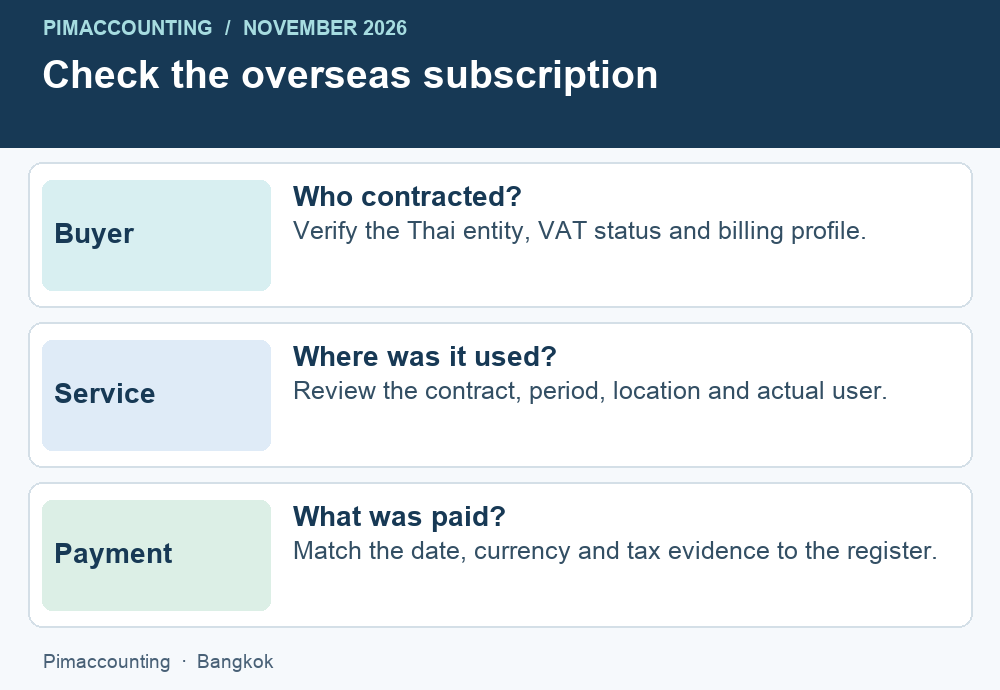
Start with the corporate card statement, overseas bank transfers and expense reimbursements. Add invoices received directly in the software platform and charges paid by a parent company on the Thai entity’s behalf. List the original currency, payment date, invoice date, supplier, service period, contractual buyer and any tax already charged. Keep the exchange-rate evidence relevant to the transaction. A bank’s eventual settlement in baht and the amount required for tax reporting may need a reconciliation.
Consider three October items: a subscription billed directly to a Thai VAT-registered company, a platform purchase made by an individual and a recharge from a group company. All three might appear in a ledger called “software”. They do not necessarily warrant identical VAT or withholding treatment. For the recharge, obtain the group agreement and the underlying service description. For the individual purchase, establish whether the person acted for the company and what evidence supports reimbursement. For the direct subscription, confirm what the supplier actually charged and why.
Separate supplier VAT, recipient remittance and withholding
A common mistake is to tell accounts payable that “foreign services are seven percent” and leave it to the clerk to choose a form. There are several distinct decisions. Did the supplier charge Thai VAT? Does a recipient remittance obligation arise on these facts? Is any input tax recoverable, with what evidence and in which period? Does a separate income tax withholding question arise under the contract and any applicable treaty? One yes or no does not answer the others.
Suppose a supplier invoice already includes a line described as tax. Identify the jurisdiction, legal basis, billing account and period before treating it as Thai tax or assuming that it satisfies a recipient obligation. If the supplier used the wrong customer status, ask how it will correct the billing profile and the affected document. Keep the correspondence. Deducting an amount from the next payment without agreement can create a supplier dispute while leaving the original reporting question unresolved.
Make the close reproducible
Assign every item one of three review statuses: covered by a documented decision, awaiting a specific piece of information, or escalated for advice. Include a short explanation with recurring suppliers and revisit it when the contract, buyer, use or tax registration changes. A new product purchased from an existing vendor can have different characteristics. Save the approved register beside the return, submission acknowledgement, evidence of payment and any official receipt used for a later accounting entry.
At the next close, compare the recurring vendor list with the card statement before the filing date. Investigate new names, renewals and unusual annual subscriptions. If a payment from an earlier month was missed, preserve its original date and seek advice on the correct way to address the earlier period. Entering it as this month’s purchase because the invoice was found today obscures the facts that an adviser needs to determine the remedy.
A useful question for your finance provider
Ask your accountant to explain one overseas subscription from contract to cash payment, tax decision and ledger entry. If the answer depends entirely on the vendor’s brand name, the controls are too shallow. Good bookkeeping records the reasoning once and makes recurring purchases easier to check without ignoring changes. A short list of exceptions, supported by contracts and payment evidence, gives a director a clearer view of risk than a large spreadsheet full of unexplained tax percentages.
Pimaccounting can work with your Bangkok team on tax return preparation and accounting for recurring purchases. Describe the overseas charge you need help classifying. For the initial discussion, give the service type, buyer’s VAT status, month of payment and whether the invoice shows tax. Leave card details and account credentials out of the enquiry.