
A submitted application, an approval and an issued work-permit document represent different stages. For a foreign founder preparing to manage a Bangkok company, the practical question is which evidence establishes permission for the duties planned today. Check that evidence alongside immigration permission and the actual employer, role and workplace.
The Ministry of Labour’s July 2026 temporary-permit announcement makes this distinction especially useful. It addresses people already approved to work whose regular permits cannot yet be issued because of operational difficulties. It does not turn every pending application into permission to begin.
1. Decide which evidence permits the first working day
The MFA’s Non-B guidance says a holder wishing to work must obtain work permission before starting. A visa supports entry for its stated purpose; permission to stay governs the immigration position. Neither should be substituted for the separate employment authorization.
On 10 July 2026, the Ministry announced temporary permits using Form บต.62. It reported Gazette publication on 9 July and effectiveness from 1 July 2026. This is an implemented measure according to the Ministry, rather than a proposal. The underlying Gazette instrument was not independently retrieved for this guide.
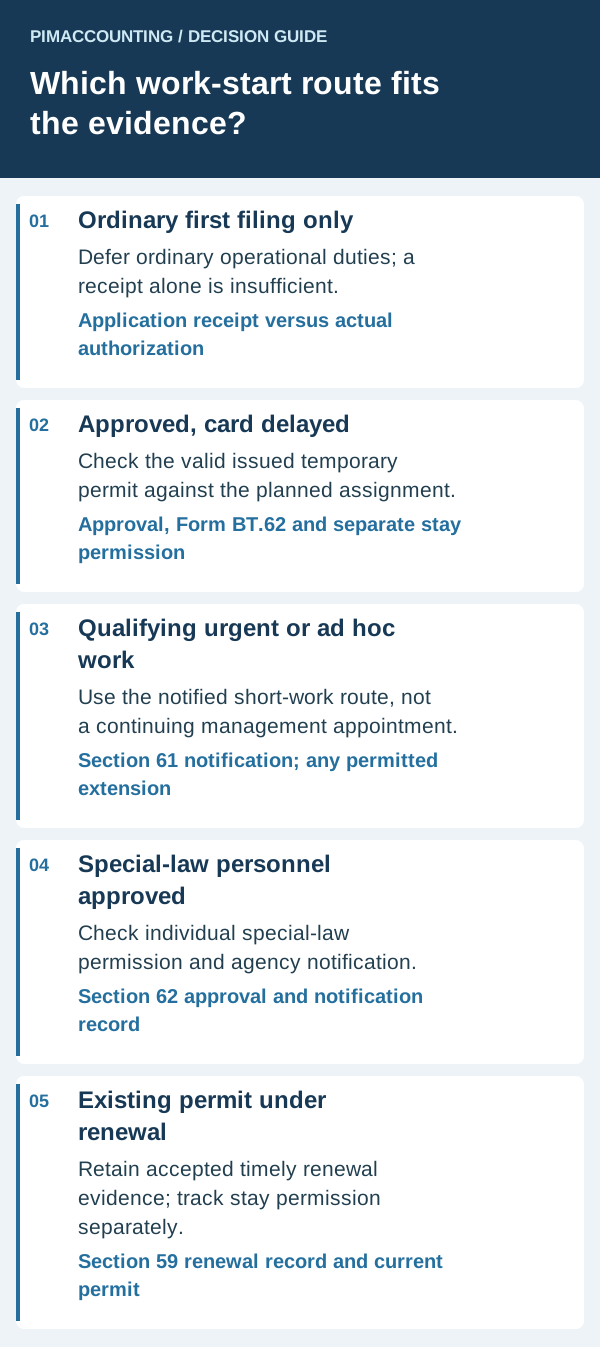
Its qualifying situation is prior registrar approval followed by an issuance difficulty. Retain the actual approval and issued temporary permit, and check their applicability before assigning work. A filing receipt or an adviser’s statement that approval is expected does not establish those facts.
| Situation | Decision | Evidence to examine |
|---|---|---|
| Non-B visa and first-application receipt only | Defer ordinary employment duties pending permission | Visa, entry record and actual authorization decision |
| Approved, regular document delayed | Check eligibility for an issued temporary permit | Registrar approval and Form บต.62 |
| Regular permit available | Compare permission with the intended assignment | Permit, employment records and stay permission |
| Existing permit approaching expiry | Establish the applicable renewal and continuity rules | Current permit and accepted renewal evidence |
| LTR local-employment permit processing | Check the distinct LTR interim-work provision | LTR category and submitted work-permit request |
2. Classify the work before choosing a route
Write down what the founder will actually do: supervise staff, negotiate assignments, deliver technical services or manage operations. Share ownership and an unpaid arrangement do not, by themselves, resolve permission. The officially hosted decree translation defines work broadly and prohibits unauthorized work and assigning duties beyond a person’s rights. Its disclaimer states that the Thai text alone has legal force.
Section 4 of the original decree excludes duties performed specifically as diplomatic or consular personnel, UN/member-state representatives and specialized-agency personnel, their private servants arriving from abroad, and missions under a Thai-government agreement with a foreign government or international organization. The 2018 amendments replace the occasional-meeting and prescribed investment/skills branches and add licensed foreign-juristic-person representatives. Match the exact capacity and prescribed conditions: an ordinary company appointment is not a diplomatic mission.
Section 61 covers prescribed necessary, urgent or ad hoc work completed within 15 days after written notification to the registrar. A preferred launch date is not enough. The 2020 procedural regulation, clauses 15–17 allows one further extension of at most 15 days, requested before the first period ends; retain the registrar’s acknowledgement and the extension record. Do not convert this narrowly defined route into permission for continuing ordinary management.
For BOI or other qualifying special-law personnel, Section 62 requires the relevant agency to notify the registrar without delay after the individual is permitted to enter and work. The registrar issues the permit within seven days of notification, with interim work allowed during that process. Keep the individual permission and agency-notification evidence. A company’s promotion certificate alone does not establish that its founder has reached this stage.
Screen tasks against the DOE’s occupation guidance. It distinguishes absolute prohibitions from treaty, professional, skilled-work and MOU conditions. Legal services, tour guiding and secretarial work appear among prohibited categories; accounting, engineering and architecture have conditional treatment. A founder title cannot override an occupation restriction or professional licensing requirement.
3. Build a sponsor file that survives scrutiny
For the ordinary business-necessity extension of stay, Immigration Order 12/2568, criterion 2.1(A) and Annex A requires the nationality-based income in its table, alongside employer and other criteria. For example, the French-national category is THB 50,000 monthly; South Korea is THB 45,000. The ordinary business branch also requires at least THB 2 million paid-up company capital and a 1:4 foreign-to-permanent-Thai employee ratio, with specified exceptions. These are immigration-extension criteria, not a universal salary threshold for issuing every work permit. A permit does not itself grant the extension, and meeting the income test alone does not authorize work. BOI and specified industry/startup branches must be assessed separately.
The OSOS ordinary sponsorship overview separately describes its THB 2 million-per-foreign-worker planning benchmark. Reconcile the actual DOE category and immigration branch before staffing or funding commitments. OSOS confirms that capital can fund operations: it is not a permit fee or a frozen security deposit. Foreign majority ownership alone does not establish the applicable test.
The DOE Section 59 checklist requests identity and immigration evidence, qualifications, a medical certificate, employment certification and any required professional licence. Corporate evidence includes registration, shareholders, VAT records, available accounts, tax/SSO records and any applicable foreign-business permission. The precise combination depends on employer type. Names, signatures, address and actual duties must reconcile across the file.
If evidence is incomplete, the procedural regulation, clause 5 requires a deficiency record and a deadline to correct it. Missing that deadline can close the file. Ask for an explicit document list and retain the correction receipt; do not mistake an initial upload for acceptance of a complete application. The MFA’s separate visa checklist and consular decision still apply.
The following ownership checklist is suggested office practice, not an additional statutory filing. Apply the DOE checklist to the actual employer and category.
| Owner | Evidence to collect | Control before filing |
|---|---|---|
| Founder | Passport, stay records, qualifications and employment history | Reconcile names, passport numbers and previous Thai employment |
| Company administrator | Registration, shareholders, licences, address and signing authority | Confirm current corporate identity and authorized signatures |
| Accountant | Available accounts, tax returns and VAT registration | Explain genuinely unavailable documents and reconcile filed periods |
| HR or payroll owner | Contract, employment certificate, remuneration and relevant SSO records | Match actual duties and route-specific evidence |
| Application coordinator | Current receiving-office checklist, submission and decision records | Separate filing, approval and issuance evidence |
For the applicant, check medical-document validity against the current receiving-office checklist. Arrange certified Thai translations and signed copies where required; regulated work needs its own Thai professional permission. A current portal checklist takes precedence over a legacy handbook’s screen names or forms.
Coordinate the company file through company-registration support and payroll support. Our BOI or FBL guide explains the separate business-activity authorization decision.
4. Connect consular approval, entry and document issuance
The MFA Non-B guidance connects employer pre-approval, consular visa assessment and entry, and makes clear that the visa is not work permission. Confirm the current pre-approval document and employment checklist with the responsible post; do not treat business-meeting travel as an employment approval. In-country conversion is discretionary, so resolve it before depending on a start date.
The government’s e-WorkPermit launch guidance confirms online registration, application/document checking and service-centre appointments from October 2025. After approval and the applicable payment steps, attend the appointment for biometric identity verification and card issuance. Its approximately 12-minute figure concerns the centre’s biometric/card service, not the whole application or a guaranteed approval time.
For ordinary Section 59 applications, the DOE public-service record states three working days from a complete file, excluding an additional ten-working-day investigation where required. Preparation, visa assessment, corrections and a later card appointment add time. The statutory procedural decision period is separate: clause 6 specifies written notification within 15 days after a complete application. Do not combine these different clocks into a guaranteed first working day.
An existing booklet and a missing online record require reconciliation, not disposal. The DOE’s November 2025 transition notice acknowledged missing employee-permit records; its temporary fallback windows are historical and must not be reused in November 2026. Retain the booklet, permit number and expiry, and obtain the registrar’s confirmation of the current record and any exchange instruction. The portal launch notice does not establish a blanket cancellation date for every booklet.
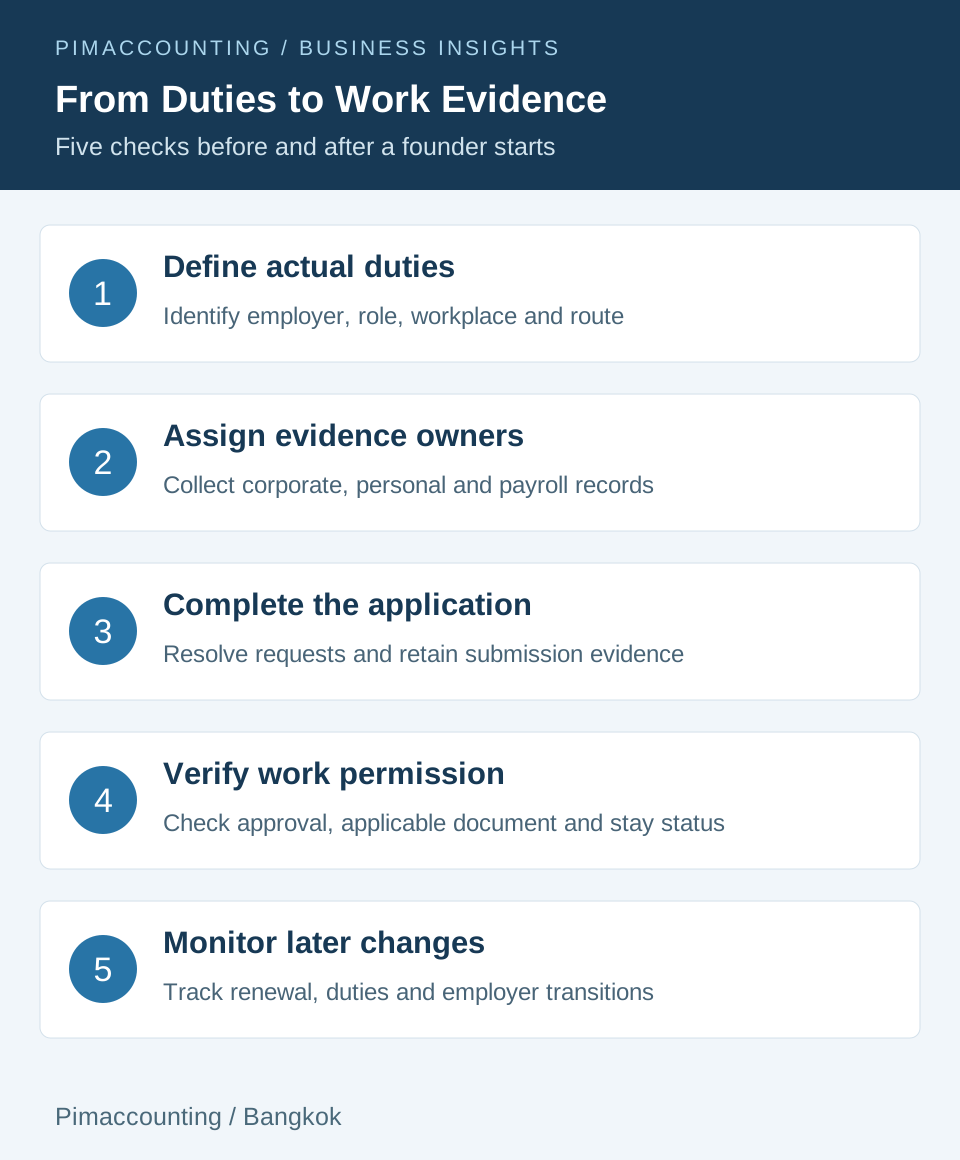
Before a temporary-permit handover, compare identity, passport, visa, employer, position and workplace with the actual assignment. The Ministry’s Form บต.62 description also includes healthcare-right information. Recording that information should not be interpreted as independently creating medical coverage. Check the issued document’s validity and conditions and retain a readable copy.
5. Test BOI staffing and remuneration before appointment
The BOI personnel FAQ explains conditions under Announcement Por.8/2568. Its 70% Thai-employment requirement applies to the specified manufacturing population exceeding 100 employees, not every promoted company. The calculation uses company Thai employees and BOI manufacturing foreign personnel, with exclusions including specified temporary personnel, MOU workers and foreign personnel outside the relevant manufacturing rights. The FAQ distinguishes projects promoted before 5 June 2025 (effective 1 January 2026) from those promoted after that date (effective 1 October 2025). Both dates have passed; check the project’s promotion date and its actual approved position.
SSO evidence remains required even below that population threshold. For companies with up to 30 BOI foreign personnel across manufacturing and services, the FAQ describes annual submission of the preceding December wage evidence within February. For the specified manufacturing group with more than 30, it describes quarterly updates counted from the wage month last submitted. Missing or overdue evidence can block placement or extension applications. Confirm the classification for mixed activities rather than extrapolating.
The FAQ says required SSO evidence cannot be redacted. It offers restricted access through the payroll or HR employee’s Single Window account, with other users unable to view evidence they did not submit. Assign that responsibility before requesting confidential payroll records.
Income requirements also depend on actual classification. The FAQ states THB 150,000 monthly for executives; management generally THB 75,000 or THB 50,000 with the qualifying degree treatment; ordinary operational roles THB 50,000; and separate treatment for engineers, researchers, IT specialists and specified TISO operators. It identifies an exception for temporary personnel with permitted stays of no more than six months. Verify the exact position rather than importing these figures into ordinary Non-B cases.
A production manager must use the classification matching the actual duties. A previously approved General Manager classified as management can retain that approved level until leaving the role, according to the FAQ’s transition. Placement contracts must price remuneration: unvalued accommodation or a driver cannot close a shortfall. An overseas-parent contract needs an assignment letter signed by an authorized director of the Thai promoted company.
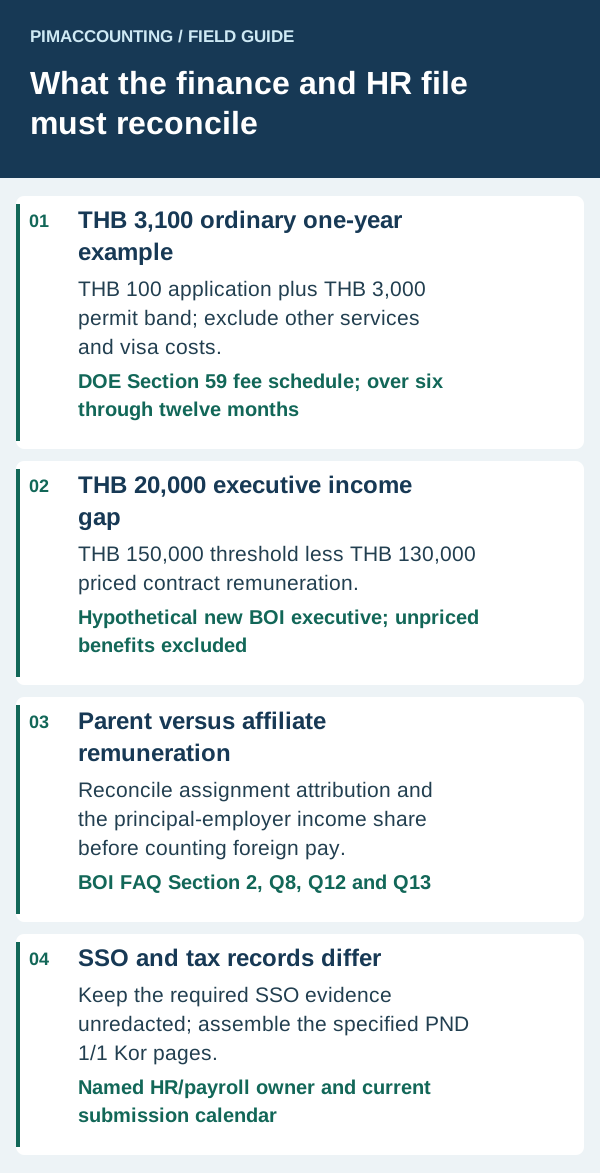
For BOI renewal, use PND 1 Kor or at least three months of PND 1 where employment has not covered its annual cycle. Where the person left the previous role no more than one year ago, the FAQ’s Thai Q11 calls for the new contract and PND 1/1 Kor showing income for the new role; the period does not run from first joining the company. For authorized-affiliate income, more than half must come from the principal BOI employer. The FAQ’s parent-company renewal example instead requires certification that the declared income arises entirely from the Thai assignment. Preserve that distinction: reconcile contracts, PND 90/91 and director certification; unrelated investment or unauthorized-work income cannot fill a gap. Have BOI confirm a mixed arrangement before counting it. Coordinate through BOI visa and work-permit support.
6. Apply the checks to a Bangkok handover
Hypothetical example: A foreign-owned Bangkok technology company appoints its founder to manage operations. Assume ordinary employment, appropriate immigration status, no applicable exclusion and no BOI promotion. The company has submitted its first application, but has only a receipt. The suggested internal decision is to defer the founder’s operational handover until applicable authorization is established.
Worked exception to the start decision: Hold every other assumption constant but add registrar approval and an issued Form บต.62 applicable to this founder. If the document is valid, matches the assignment and separate stay permission remains valid, proceed with the authorized handover. If identity, duties or employer do not match, defer and correct them. Approval without the applicable issued evidence does not satisfy this hypothetical ordinary-route control.
Additional hypothetical BOI control: A newly appointed executive has THB 130,000 contractual remuneration plus accommodation without a monetary amount. Against the FAQ’s THB 150,000 executive threshold, the documented gap is THB 20,000 monthly. Correct the remuneration evidence before filing; changing the title while retaining executive duties does not solve it.
The DOE Section 59 fee schedule lists THB 100 to apply, plus THB 750 for up to three months, THB 1,500 for over three through six months, or THB 3,000 for over six through twelve months. The last band therefore totals THB 3,100 with the application. Additional periods, visa, medical, translation and professional fees are separate. A change notification is not automatically a fresh one-year permit: obtain the route-specific assessment rather than recycling historical amendment tariffs.
7. Protect continuity through renewal and changes
The current DOE Section 59 renewal record specifies filing within 30 days before expiry, with registrar acceptance earlier where necessary. Keep the accepted renewal receipt: qualifying work may continue pending a refusal, but stay permission remains separate. Renewal is granted only as necessary, for no more than two years at a time. The service record states two working days for the complete-file process, excluding any additional ten-working-day investigation.
For a lost, destroyed or materially damaged permit, the DOE replacement manual requires an application within 15 days of learning of the loss or damage, and before expiry. Its ordinary fees are THB 100 application plus THB 500 replacement. Retain a police report for loss/destruction, a copy of the old permit if available and identity evidence; attend collection personally. This replaces a document, not an expired authorization.
Separate the two notification duties in the amended decree. Section 13 requires the employer to report hiring and departure within 15 days, subject to prescribed exceptions. Section 64/2 requires the permit holder to report employer, workplace and work characteristics within 15 days of employment and again on changing employer. Before a new assignment, reconcile the new contract, permitted activity, immigration sponsorship and any special-route approval; file the appropriate employment/change record with DOE. Reporting does not waive a BOI placement condition or authorize a prohibited profession.
Section 95 gives a 30-day ministerial appeal from notification of specified refusals under Sections 59, 60, 63, 63/1, 63/2 or 64, non-renewal under 67 or revocation under 90. Obtain the written decision and its reasons promptly. An appeal is not, by itself, an extension of work or stay permission.
8. Use the distinct LTR branch where applicable
The LTR issuance guidance requires local-employment work-permit applications and expressly allows temporary work while the qualifying request is processing. It gives an indicative three-to-five-working-day process, subject to additional documents, and a THB 3,000 annual permit charge. This is a distinct provision, not the ordinary application-receipt rule.
The LTR FAQ includes Wealthy Global Citizens, Wealthy Pensioners, Highly Skilled Professionals and Dependents among categories able to apply. An employment certificate is required. Dependent status alone does not grant employment permission, and eligibility to apply remains subject to the individual requirements.
Work-from-Thailand Professionals are excluded from this work-permit route; the FAQ says they cannot take income-generating work with Thai employers under that category. Other remote-work situations require their own route analysis.
For LTR-H employer transitions, the FAQ says to notify staff at least one month before the existing contract ends. The issuance guidance requires official approval of a qualifying new employer before termination of current employment. If the new employer fails the LTR criteria, the existing LTR-H must end with that employment. Sequence approval before resignation.
Adding a second employer uses the LTR system’s Digital Work Permit ADD request. Correcting company details is separate: the FAQ describes contacting staff for certification and a THB 400 DOE payment. After losing a passport abroad, file a police report and contact LTR staff for format-specific instructions before arranging re-entry.
Frequently asked questions
Who should keep the original permit?
Keep it accessible to the worker. Amended Section 131 penalizes confiscation; consensual safekeeping must allow access whenever requested. Company administration should retain a readable copy rather than prevent the holder from producing the original.
Which tax-return pages does BOI request?
The FAQ specifies the receipt, withholding return, attachment pages listing foreign personnel and the final totals page for PND 1/1 Kor. Separate this targeted tax bundle from the unredacted SSO evidence requirement.
What if a BOI company hires additional Thai staff?
The FAQ permits an updated latest SSO form at any time to record new hiring. Recalculate the next submission using the applicable annual or quarterly rule; one update does not remove ongoing monitoring.
Does a temporary permit’s healthcare field grant insurance?
Form บต.62 records healthcare-right information. Recording a field is not independent evidence that medical coverage has been granted; check the actual entitlement and enrollment separately.
What are the consequences of unauthorized employment?
The DOE penalty explanation identifies worker fines of THB 5,000–50,000 and removal, and employer fines of THB 10,000–100,000 per worker, with enhanced repeat-employer sanctions. Our Thai VAT and monthly-close guide explains another set of company records to coordinate separately from work permission.
Scope checked on 17 November 2026. General guidance for route selection and evidence preparation; individual permissions and the Thai legal text govern. Official English translations aid understanding but have no independent legal authority. No approval, processing or eligibility outcome is guaranteed.
Sources and further reading
- Ministry of Labour announces temporary work permits for approved foreign workers awaiting regular permits — 2026-07-10
- Foreigners’ Working Management Emergency Decree (No. 2), B.E. 2561: English translation
- Non-Immigrant Visa B: business and work — 2019-08-20
- FAQ: Employment Conditions for Foreign Personnel under BOI Announcement Por.8/2568
- LTR visa issuance and work-permit procedures
- LTR frequently asked questions
- Department of Employment explains prohibited occupations and conditional exceptions
- Foreigners’ Working Management Emergency Decree B.E. 2560 (2017), English translation — 2017-06-22
- DOE public-service record: ordinary Section 59 first work-permit application
- DOE public-service record: ordinary Section 59 renewal
- Thailand Enhances Foreign Work Permit Service — 2025-10-09
- OSOS FAQ: ordinary-company work-permit investment capital and Thai staffing
- DOE manual: replacement of ordinary Section 59 work permit
- DOE e-WorkPermit transition facilitation notice — 2025-11-02
- Ministerial Regulation on work-permit applications, issuance and work notifications B.E. 2563 — 2020-08-31
- Immigration Order 12/2568: business-necessity extension criteria and Annex A income table