

Choosing between BOI promotion and a Foreign Business Licence starts with defining what your Bangkok company will actually sell. The useful comparison is between the permission basis for each proposed activity, the project scope that may qualify for promotion, and the evidence needed to move from an application to an operating business.
A company registration, BOI approval notification, promotion certificate and Foreign Business Certificate serve different purposes. Build your launch plan around those distinctions before committing to customer delivery dates. This guide explains the document sequence and the questions founders should resolve with the relevant authorities and advisers.
What the October investment figures tell founders
The BOI press release dated 27 October 2026 reports investment applications worth 1.71 trillion baht in January–September 2026, up 28%. Its Bangkok dateline is 26 October. These are application figures: they do not measure completed investment, operating companies or the likelihood that another founder’s project will qualify.
The release separately reports approved projects. That distinction matters when reading headlines about investment inflows. Submitting a proposal, receiving approval, obtaining the promotion certificate and implementing the project are separate milestones. The BOI procedure brochure also identifies later incentive applications and project operation-start-up procedures.
For a founder, the practical lesson is to attach evidence to each milestone. An application reference supports a statement that an application exists. An approval notification supports a different statement. Neither should be described to a customer, investor or landlord as proof that every proposed business activity is already authorised.
Start with a revenue activity matrix
Prepare a plain-English description of every proposed revenue stream before asking whether BOI or an FBL is appropriate. Labels such as “technology company”, “regional headquarters” or “consultancy” are too broad for a useful scope review. Describe the deliverable, who buys it, who performs the work, where delivery occurs and which entity signs the contract.
For example, developing software, implementing a customer’s existing system and providing general business advice may appear in one commercial proposal. Keep them visible as separate activities for assessment. This is a working method for identifying questions; it does not determine their legal classification.
| Field | What to record | Why it helps |
|---|---|---|
| Deliverable | The product or service promised in the contract | Replaces broad marketing descriptions with facts |
| Customer and location | Customer type, contracting entity and delivery locations | Makes the proposed operating model understandable |
| People and resources | Who performs the work and the resources used | Connects the proposal to actual project substance |
| Revenue basis | Subscription, project fee, retainer or other charge | Helps reconcile contracts, budgets and accounting |
| Permission question | Proposed route and unresolved scope questions | Prevents assumptions from becoming launch decisions |
Add the proposed ownership structure as a separate attachment. Ask for an activity-specific assessment of the applicable foreign-business position and any other relevant permissions. The sources used here do not establish a universal ownership threshold, activity exemption or entitlement for your business. Pimaccounting’s company setup guidance provides a starting point for organising the wider establishment work.
Understand the certificate and licence distinction
“BOI or FBL?” can obscure the fact that BOI promotion and foreign-business permission are different assessments. The Department of Business Development procedural guide describes a Section 12 Foreign Business Certificate process for qualifying businesses under investment-promotion and other specified laws. It separately describes the Section 17 Foreign Business Licence application process.
For the promoted-business route, the guide depicts an online BOI-to-DBD handoff of the application and supporting documents. It also shows DBD review and approval stages. Treat this as a distinct permission workflow to confirm, rather than assuming that a BOI approval notification completes the foreign-business process.
The Section 17 diagram describes consideration of the business application and supporting documents, followed by the relevant decision and licence stages. It should not be treated as a fallback that automatically succeeds when promotion is unsuitable. The underlying activity and applicable requirements still need assessment.
The same DBD guide separately addresses a Section 11 treaty route. Where a treaty or another statutory basis may be relevant, ask for that route to be assessed on its own facts. The guide is undated; its channels, forms and administrative details should be reconfirmed before filing. It does not announce a new 2026 rule.
Define the project that promotion would cover
The BOI brochure’s approval criteria state that promotion is considered on a project-by-project basis and that a project must fall within eligible activities and comply with the conditions for the activity. This makes the proposed project boundary central to the review.
Compare the activity matrix with the application narrative, financial forecast and draft customer contracts. If one document describes software development while another budgets substantial general consulting fees, resolve the discrepancy before relying on a single project description. Ask which activities the proposed promotion would cover and how additional activities should be assessed.
Use version control for the scope description. Record the date, the assumptions discussed and any written agency clarification. Where a question remains open, label it open. A meeting note saying “discussed with officer” should not silently become “approved” in the board’s launch checklist.
Accounting design should follow the same boundaries. Separate revenue codes and identifiable project costs can make later review more manageable. Pimaccounting’s BOI accounting and compliance support concerns organising project accounts and conditions; the relevant authority determines promotion and permission outcomes.
Build the sequence around evidence handoffs
The BOI investment promotion procedure distinguishes application submission, project clarification, evaluation, notification, acceptance and certificate issuance. Its general-business certificate checklist then calls for corporate and funding documents. Plan how those records will be produced before the certificate package becomes urgent.
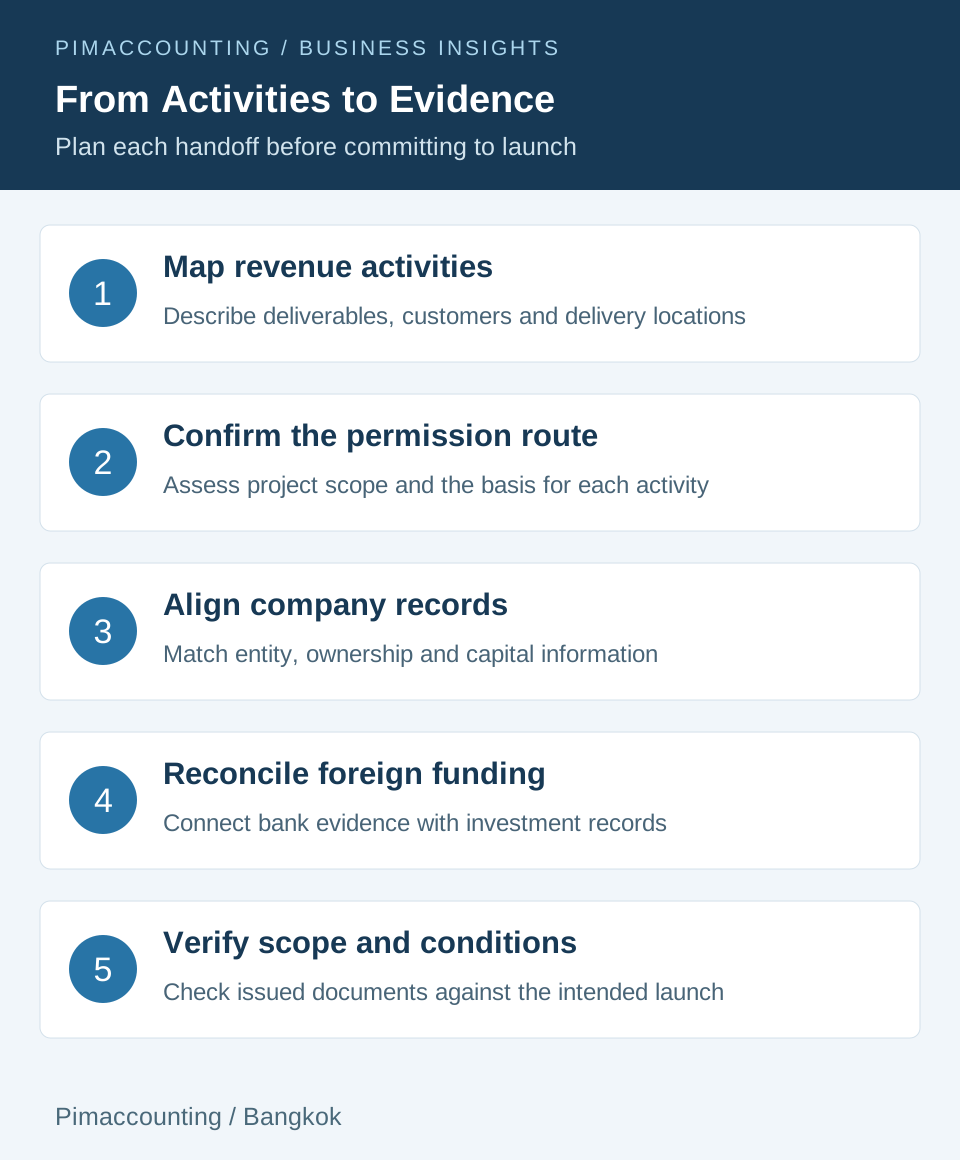
First, maintain a stable activity description and ownership chart. Second, record the proposed permission basis and the questions requiring confirmation. Third, coordinate company documents so the entity name, shareholders, nationalities, capital information and authorised signatories agree across the relevant records.
Fourth, reconcile the foreign funding evidence with the corporate documents and accounting records. Fifth, check the issued certificates, their activity descriptions and their conditions against the intended launch. These are management checkpoints; they do not replace the agencies’ formal requirements.
Keep supporting documents with the transactions they explain. Our guide to organising business records covers practical filing habits.
Prepare foreign funding records before submission
For general businesses, the BOI certificate issuance checklist includes the application form, utility and labour requirements, a capital-increase memorandum where applicable, company registration documentation, and a certified shareholder list showing nationalities. It specifies validity within one year for the listed registration certificate and shareholder document.
For foreign shareholding, the checklist requests proof of foreign fund transfer, described as credit advice stating investment purpose only. It also allows for additional documents specified in the approval notification for the particular activity. Read that notification alongside the general checklist. See the general-business procedure on page 18 of the BOI guide.
Before arranging a transfer, ask the receiving bank what evidence it can provide and confirm the documentary requirements with the responsible BOI officer. Record the investor, beneficiary, transfer reference, currency, amount and stated purpose. Retain the bank-issued evidence alongside the documents explaining the investment.
If a remitter differs from the proposed shareholder, or a transfer description is inconsistent with the intended investment, flag the issue for review. Do not assume a bank statement alone resolves it, or alter the accounting description simply to match an application. A genuine transaction needs a consistent, supportable explanation.
The historical OBOI Regulation No. 1/2553 English translation also lists shareholder-nationality and overseas-transfer evidence. This corroborates the documentary theme; the translation is unofficial and should not be used as a current checklist or as the controlling legal text. For the company-record side, share-capital administration support can help organise payment evidence and connected records.
Keep the three BOI timing triggers separate
The BOI Investment Promotion Guide 2026, page 18 identifies three different timing points. It states that acceptance must be confirmed within one month from receiving the notification. The application for promotion certificate issuance, with supporting documents, must then be submitted within six months from resolution acceptance.
The brochure states that BOI will issue the promotion certificate within ten working days from receiving the complete form and documents. That complete-document condition matters. The stated period is not an end-to-end estimate covering activity assessment, incorporation, bank arrangements, missing-document corrections and DBD permission. See the general-business procedure on page 18 of the BOI guide.
Create separate diary entries for notification receipt, acceptance and certificate submission. Keep evidence of each event and distinguish a submission receipt from confirmation that the package is complete. Confirm the requirements applicable to the actual notification; do not build a launch budget around an assumed extension.
A practical cash forecast should also distinguish planned spending from permission-dependent revenue. Budget for preparation and possible document corrections without presenting an administrative timeframe as a guaranteed trading date. The historical regulation is not used here to assert current extension rights.
Hypothetical: software development plus consulting
This is a fictional planning example, not a client result or an eligibility conclusion. Two foreign founders propose a Bangkok company offering software development and separate management consulting. Their internal annual revenue forecast is 8 million baht for development and 2 million baht for consulting.
The calculation is straightforward: total forecast revenue is 10 million baht, and consulting represents 2 million divided by 10 million, or 20%. That percentage has no stated legal significance here. It shows why treating the whole business as one undifferentiated “technology project” could conceal a material scope question.
The founders prepare separate descriptions, sample deliverables and draft contract schedules for each stream. They ask whether the development project fits an eligible BOI activity and what permission basis applies to the consulting work. Until those questions are resolved, the forecast does not label consulting revenue as covered by promotion.
They also prepare a funding reconciliation linking the proposed shareholders, corporate records and available bank evidence. An unexplained transfer remains an unresolved item rather than being included as accepted investment evidence. Their accountant proposes separate revenue codes so later invoices can be traced to the agreed activity descriptions.
When a shareholder transfer reaches the company account, use bank reconciliation to match the ledger entry to the statement and record any difference for review.
Assemble a founder review pack
Keep one indexed pack containing the activity matrix, ownership chart, project narrative, latest corporate documents, funding reconciliation, approval correspondence and unresolved questions. Add a conditions register once formal documents are available. For each condition, record the required evidence, responsible person and next action.
Before authorising launch commitments, compare the intended contracts with the confirmed scope and applicable permissions. Record any discrepancy for resolution. Keep incentive assessment separate: eligibility, conditions and accounting treatment need their own review, and no tax saving is calculated in this guide.
Arrange bookkeeping support early enough to preserve the links between transfers, capital records, expenditure and revenue. An orderly ledger cannot replace permission, but it gives the company a consistent record of what actually happened.
Frequently asked questions
Does BOI application submission mean we can start trading?
No such conclusion follows from submission. The BOI procedure brochure separates submission, evaluation, approval and certificate stages. Confirm the permission basis for each intended activity before treating it as ready to operate.
Is a Section 12 certificate the same as an FBL?
They are different procedural routes. The DBD guide separately describes a Section 12 Foreign Business Certificate for qualifying businesses and a Section 17 Foreign Business Licence application.
Will promotion cover every service our company sells?
Do not assume company-wide coverage. The BOI brochure describes project-by-project consideration and activity conditions. Match additional services against the confirmed project scope and seek a separate assessment where needed.
What foreign funding evidence should we prepare?
The BOI Investment Promotion Guide 2026, page 18 requests foreign-transfer credit advice stating investment purpose where there is foreign shareholding. Confirm the applicable documents before remitting and reconcile the evidence with shareholder and company records.
Can we promise a launch ten working days after approval?
The brochure’s ten-working-day issuance period starts with receipt of the complete certificate form and supporting documents. It is not measured from project approval and does not establish completion of separate DBD or other applicable requirements.
Should incorporation wait until every question is settled?
There is no universal sequence established by these sources for every project. BOI’s certificate checklist requires corporate documents, so plan their preparation alongside the permission review. Resolve activity and ownership assumptions early enough to avoid preparing records around an unsuitable structure.
The filing periods described here are those in the July 2026 edition of the BOI guide. Confirm the instructions and dates in your project notification before filing.
Sources and further reading
- Thailand Investment Applications Jump 28% as AI Projects Fuel US$50.3 Billion Pipeline — 2026-10-27
- BOI overview: Investment Promotion Application Procedures
- OBOI Regulation No. 1/2553: Time Frame for Investment Promotion Procedures (unofficial English translation)
- How to Get the Certificate / How to Get the Licence
- Thailand Board of Investment, Investment Promotion Guide 2026, p. 18