


For a foreign-owned business building its finance function in Bangkok, Thailand’s electronic withholding-tax incentive can improve supplier cash flow and simplify evidence collection. The useful question is not simply whether the rate is 1%. It is whether the particular payment qualifies, whether the correct electronic route is used, and whether the accounting records prove what happened.
- Review eligibility before changing a supplier’s tax code.
- Separate a lower withholding amount from a reduction in final income tax.
- Keep invoice, payment and electronic tax evidence together.
- Use a controlled pilot before moving the entire supplier ledger.
What changed in October 2026?
Ministerial Regulation No. 402 was published in Thailand’s Royal Gazette on 9 October 2026. It provides a 1% withholding rate for specified income paid from 1 January 2026 to 31 December 2027 when remittance follows the prescribed electronic method. The concession is limited by payment category and recipient status. It is not a universal tax rate for every invoice or bank transfer. Read the enacted regulation (Thai, PDF).
The Revenue Department had announced the proposed extension on 16 June. Its announcement described two separate measures: a reduction of selected withholding rates through e-Withholding Tax and incentives for qualifying electronic-tax expenditure. Keeping those measures separate prevents a common budgeting mistake: treating reduced withholding, a possible additional expense deduction and lower administrative costs as if they were the same benefit. Revenue Department announcement 14/2569.
This timing matters for a company reviewing its 2026 records. A finance team may have read an earlier article describing a proposal, while a bank or adviser now refers to enacted legislation. Retain the current legal source in the company’s tax-policy folder and record when the supplier setup was reviewed. Do not backdate payment records or assume that an ordinary transfer made earlier in the year can simply be relabelled as an electronic withholding transaction.
Why this matters for foreign-owned companies in Bangkok
A Thai-incorporated subsidiary with foreign shareholders is not interchangeable with its overseas parent. The Revenue Department distinguishes companies registered under Thai law from businesses registered abroad, including foreign entities operating in Thailand and overseas recipients of Thai-source income. That distinction should be reflected in the supplier master and the contract register. Revenue Department guide to company tax status.
At launch, the founder may approve invoices from a phone, a regional finance team may release payments, and an outsourced bookkeeper may receive the documents later. That arrangement can work only if someone owns the classification decision before money leaves the bank. A tax field filled in after payment is a record of a decision already made; it is not a substitute for making that decision correctly.
Build this control alongside company setup in Thailand, bank access and the first monthly close. Ask who signs contracts, who verifies the supplier’s legal name, who selects the payment route and who checks the resulting tax evidence. A clear division of responsibilities is more useful than an impressive accounting dashboard populated with incomplete information.
Which payments need an eligibility review?
The regulation covers defined categories including certain professional fees, rent, contract work, advertising and other specified services. Recipient conditions differ, and exclusions apply. For example, the service limb does not extend indiscriminately to hotel services, restaurant services or life-insurance premiums. The underlying provision, rather than the word “service” on an invoice, determines treatment. Check the categories and exclusions.
Create a review queue around actual spending. Start with recurring suppliers because a classification error there repeats every month. Read a sample contract, invoice and payment instruction together. Does a bundled invoice contain more than one type of charge? Has the supplier changed its contracting entity? Is a payment being made to an individual, a Thai company or an overseas company? Record the answer and the supporting document, rather than copying last month’s percentage.
Use a separate review for overseas software, royalties, group management charges and other cross-border payments. The Revenue Department’s foreign-company guidance explains that certain Thai-source payments to overseas companies can fall under distinct withholding rules. An overseas address does not resolve treaty entitlement, the nature of the payment or its Thai tax treatment. Official guidance for foreign companies. Our guide to foreign software bills and P.P.36 addresses the separate VAT-remittance question.
Worked example: cash flow is not the same as a tax saving
The following is a hypothetical illustration, not a Pimaccounting client case. Assume a Bangkok company buys a qualifying domestic service for THB 100,000 before VAT. For this comparison only, assume the normal withholding rate is 3%, the electronic concession applies at 1%, VAT is outside the calculation, and there is no contractual gross-up. Bank fees are also excluded.
| Payment component | Ordinary 3% example | Eligible 1% example |
|---|---|---|
| Service fee | THB 100,000 | THB 100,000 |
| Tax withheld | THB 3,000 | THB 1,000 |
| Cash received by supplier | THB 97,000 | THB 99,000 |
| Payer’s total allocation | THB 100,000 | THB 100,000 |
The supplier receives THB 2,000 more immediately, while the payer still allocates THB 100,000 between supplier and tax. The payer has not obtained a THB 2,000 discount. The Revenue Department describes withholding as a credit against the recipient’s final tax liability, so lower withholding does not automatically reduce that final liability. Corporate income tax and withholding guidance.
Now consider the same situation from the sales side. If your Bangkok company is the supplier, a qualifying customer payment may release more cash into your operating account. That can affect the timing of payroll or a software purchase. It should still be modelled separately from profit, VAT, the annual tax provision and customer credit risk. If your contract promises a net amount after tax, ask your accountant to analyse the gross-up before using the illustration.
An online transfer is not enough: design the evidence chain
Ministerial Regulation No. 364 establishes the bank-remittance framework. It requires relevant payer, recipient, income and tax information, electronic evidence from the bank, and transmission to the Revenue Department within the agreed period, subject to a four-working-day maximum. Under that framework, remittance is completed when the department receives the tax. Read the electronic-remittance rules.
For an operational example, Bangkok Bank describes an e-Withholding Tax service that submits tax and information electronically on behalf of corporate payers. Its service materials also describe checking and downloading evidence through the Revenue Department. A business should confirm its own bank’s current channels, onboarding requirements, fees and correction procedures rather than assuming that every banking product supports the same workflow. Bank service information.
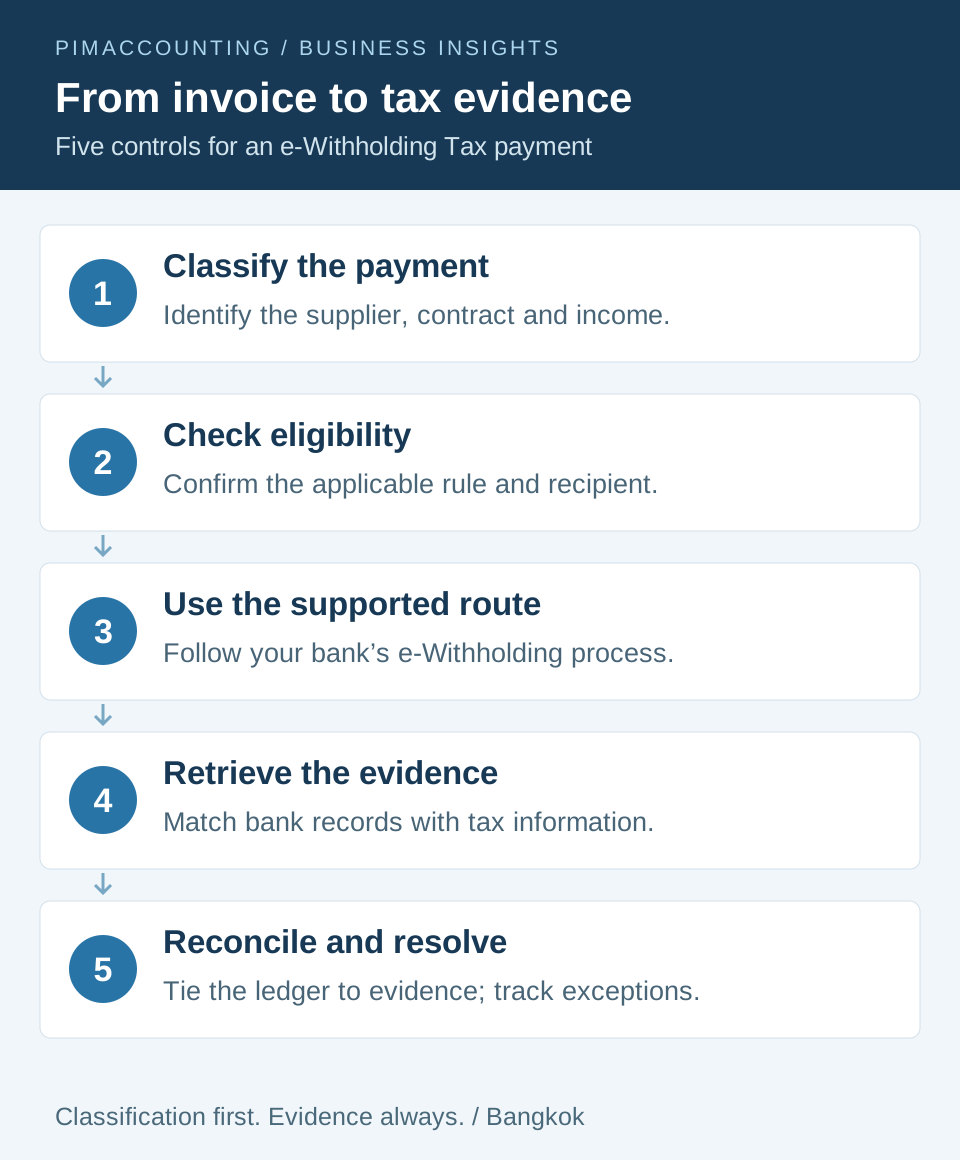
Use one transaction reference across the purchase ledger, approval note and evidence folder. Save the invoice, the reason for the chosen treatment, the payment confirmation and the electronic tax record. Where a bank batch contains multiple suppliers, retain the batch-level confirmation and the detail needed to trace each line. A reviewer should be able to reconstruct one payment without access to the original employee’s email account.
Rejected files deserve their own exception queue. A successful bank login, an uploaded instruction or a payment screenshot is not conclusive evidence that the tax record is correct. Reconcile the recipient identity, income amount and withholding amount. Assign a named owner and a resolution date to differences, then retain the correction trail. Do not send a second payment merely because an evidence record is taking time to appear.
A 30-day implementation plan for a Bangkok finance team
Week 1: map payments and responsibilities
Export the last two or three months of supplier payments and classify them by recurring purpose, contracting entity and payment channel. Identify the transactions that need specialist review. Keep payroll, cross-border charges and unusual one-off items in separate workstreams. Decide who approves the classification and who can change tax settings in the accounting system.
Week 2: configure and test a small group
Choose a limited group of straightforward recurring suppliers after their eligibility has been confirmed. Agree the rollout with the bank and verify the exact data required. Prepare a plain-English payment note for the supplier explaining the invoice amount, withholding and evidence route. Test with authorised business transactions, not duplicate or artificial payments created merely to test a system.
Week 3: reconcile the first completed cycle
Match the pilot transactions to the purchase ledger and available tax evidence. Review mismatches before expanding the group. Ask a second person to check a sample without verbal guidance: if they cannot follow the trail, improve the file names or register fields. This is also the point to test how the company handles a credit note, a cancelled instruction or a supplier correction.
Week 4: document the monthly close
Write a short procedure covering the approved categories, evidence checks, escalation contacts and access permissions. Make the month-end checklist distinguish completed transactions from unresolved exceptions. Retain a review date so that the procedure is revisited when the law, bank service or business model changes. Ongoing accounting support in Bangkok can keep the payment process connected to bookkeeping and management reporting.
Keep the separate electronic-tax expense incentive separate
Royal Decree No. 808, published on 12 October 2026, provides additional tax relief for defined electronic-tax investments and service expenditure during 2026–2027, subject to conditions. This is a different calculation from the 1% withholding concession. Asset conditions include restrictions concerning prior use, readiness for use, location, continued use and overlapping tax benefits. A generic computer purchase is not automatically a qualifying claim. Royal Decree No. 808 (Thai, PDF).
If you are budgeting a finance-system implementation, ask the vendor to separate hardware, software, configuration, storage and service fees clearly in its quotation. Preserve the scope of work and evidence of the intended use. Ask your tax adviser to assess qualifying amounts, timing and interaction with other incentives before including any benefit in an investment decision. The commercial case should still work when the tax benefit is smaller or later than initially expected.
Prepare a file that can withstand a tax review
A tax review is easier to support when the company can explain the transaction in a consistent sequence: what was bought, from whom, under which contract, when it was paid, how the tax treatment was selected and where the resulting evidence is stored. Produce that sequence during normal monthly work rather than attempting to reconstruct it after a query arrives.
Maintain a register of exceptions, not just a folder of successful payments. Useful entries include a supplier’s incorrect tax identifier, a disputed payment category, a missing document and a correction awaiting confirmation. State the financial amount, the person responsible and the next action. This makes unresolved exposure visible to management without presenting uncertainty as a settled conclusion.
Pimaccounting’s withholding-tax services and tax-return support can help organise classifications, records and reconciliations. A broader review can connect those records with annual audit preparation. These services address different responsibilities; a neatly reconciled payment file is useful evidence, but it is not a guarantee that an authority will accept every tax position.
Questions foreign business owners often ask
Does e-filing a normal tax return make a payment eligible?
Do not assume so. Electronic filing and a payment processed under the prescribed e-Withholding Tax remittance method are different steps. Confirm the route and evidence with your bank and accountant before changing the rate.
Can we set every supplier to 1%?
No. Use a reviewed category-and-recipient matrix, with a separate process for exceptions. A blanket default hides the very differences that determine the tax treatment.
Does a foreign shareholder change the treatment of every invoice?
No single shareholder label answers the payment question. Establish the legal identity of the paying company, the recipient’s status and the substance of the transaction. Keep overseas group charges separate from straightforward domestic purchases.
Can the reduced withholding be booked as extra profit?
Not simply because less tax was withheld. In the worked example, the fee is unchanged. The immediate difference is the distribution between cash received and tax withheld; the final tax calculation requires its own analysis.
What should we send Pimaccounting for an initial review?
Prepare a supplier list, sample contracts and invoices, a recent payment export, current tax settings and examples of electronic evidence. Share confidential records through an agreed secure channel. The public enquiry form only needs a brief description of the issue and the services you need.
PIMACCOUNTING · BANGKOK
Build a payment process your team can explain
Whether you are establishing a Thai subsidiary or improving an existing finance function, start with a review of your actual transactions. We can help connect bookkeeping, withholding-tax preparation and business setup so that each payment has a clear owner and a documented treatment.
Discuss your company’s accounting needsPrepared for general business information and checked against the sources below on 12 November 2026. Tax treatment depends on the transaction and applicable conditions. The numerical scenario is hypothetical; the AI-generated hero illustrates a professional setting and does not depict a real client engagement.
Sources and further reading
- Ministerial Regulation No. 402 (B.E. 2569) — 2026-10-09
- Revenue Department announcement 14/2569 — 2026-06-16
- Ministerial Regulation No. 364 (B.E. 2563) — 2020-06-19
- Royal Decree No. 808 (B.E. 2569) — 2026-10-12
- Revenue Department — Corporate Income Tax
- Revenue Department — Income Tax Guide for Foreign Company
- Bangkok Bank — e-Withholding Tax Service