


Two employees earn different salaries, yet both show THB 875 as their Social Security contribution. Is the payroll file wrong? In 2026 it can be perfectly correct. Thailand raised the maximum monthly wage base for Section 33 contributions to THB 17,500 for the first phase beginning in January 2026. At the ordinary five percent rate, the maximum employee contribution is THB 875, with the same maximum for the employer. November is a good time to test the payroll configuration before a December bonus or a change of payroll provider makes an old setup error harder to trace.
Work through the cap one employee at a time
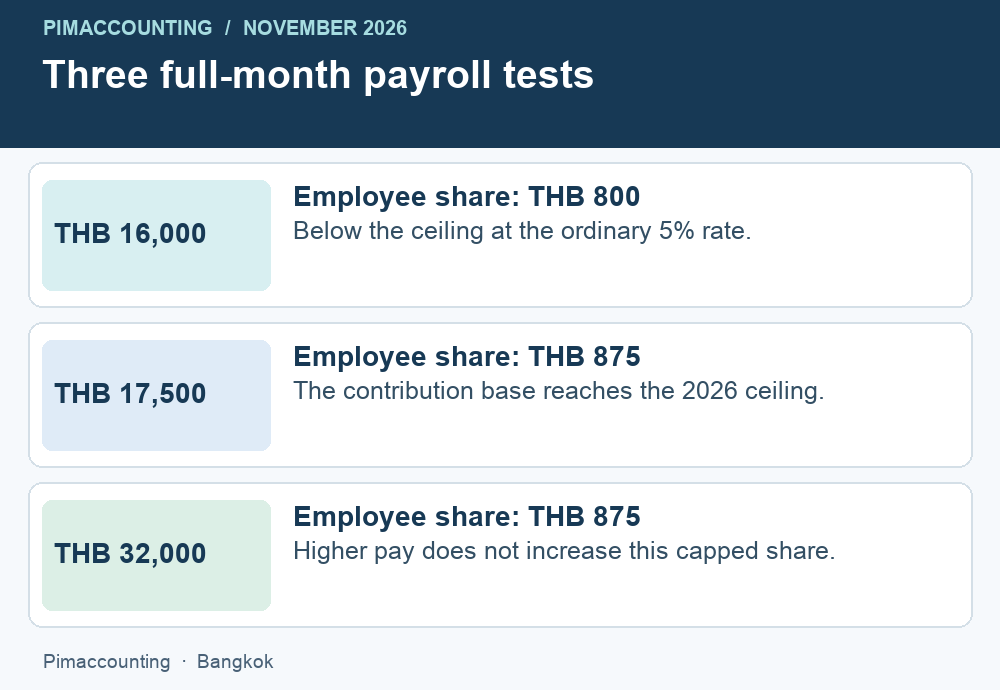
Imagine three employees covered by Section 33, each working a full month under the ordinary contribution rules. One has THB 16,000 of contributory wages, another THB 17,500 and the third THB 32,000. At five percent, the illustrative employee deductions are THB 800, THB 875 and THB 875 respectively. Apply the cap to the relevant wages for each individual. Applying five percent to total company payroll and then imposing one combined ceiling produces a different answer when some people earn below the cap.
Now look at an employee whose eligible wages rise from THB 14,000 to THB 16,000. The expected deduction in this simple case increases from THB 700 to THB 800. A program that still caps eligible wages at THB 15,000 stops at THB 750. The employee’s net pay is too high by THB 50 and the employer’s contribution is also too low. For a person paid above the new cap the same outdated setting can produce a THB 125 difference on each side. These are test examples, not a substitute for checking the actual employee’s status and month.
Find the two places where an old ceiling can survive
Many employers update their payroll program but leave a spreadsheet unchanged. The payroll program calculates the payslip. A separate workbook used for approval or an upload file for the Social Security Office may still contain the old threshold. Both files appear reasonable if a reviewer looks only at totals. Test an employee below the old ceiling, one between the old and new ceilings, and one comfortably above both. Follow all three from gross wages through the payslip, upload file and payroll journal.
Ask the provider which configuration is used when reopening a prior payroll period. The effective date matters. Recalculating a historical period with today’s settings can produce a new difference even when the original run was correct. Preserve the original payroll register, the effective-dated rate table and the reason for any correction. Avoid replacing January’s archive with a November recalculation. You may later need to explain a difference to an employee or reconcile it with an amount already remitted.
Check the wage definition before testing percentages
A payroll export often has one column called gross pay. It can contain salary, overtime, allowances, reimbursements and one-off items. Do not assume that every amount in that column belongs in the same contribution base. Maintain an earnings-code list that identifies the purpose of each payment and the basis used for its classification. Ask for specialist review when introducing a new allowance, rather than copying the treatment of another item because its name sounds similar.
New starters, leavers, unpaid absences, people with more than one employer and any applicable relief measures deserve a separate review. The full-month examples above do not settle those cases. Record the dates, employee status and any official instruction relevant to the actual month before authorising a deduction. Give your payroll team a route for escalating an unusual case without delaying the entire pay run or asking the employee to resolve an employer reporting question alone.
Reconcile employer cost and cash separately
The employee share is withheld from pay. The employer share is a company expense. Both can become payable to the same authority, but they enter the accounts from different directions. Build a monthly bridge from employee deductions and employer expense to the total contribution liability. Compare that liability with the submitted schedule and then the bank payment. A payment in the following month can be entirely consistent with a liability recognised at month-end.
If a difference appears, identify whether it originated in earnings, the employee register, the contribution calculation or the posting. Explain it by employee in a restricted payroll workspace, then give management an aggregate explanation without exposing salaries. When a past mistake is found, check the appropriate correction procedure before netting it against an unrelated employee’s next payslip. Keep evidence of employee communications and approval of any payroll adjustment.
Make the November check useful to employees
Give staff a short explanation of the wage base and where their own contribution appears. A clear example often resolves the question about two different salaries producing the same deduction. It also helps staff distinguish Social Security from income tax withholding, which is a separate calculation. At year-end, reconcile these two liabilities in separate accounts so that a payroll tax discrepancy is not mistaken for a Social Security problem.
Pimaccounting’s Bangkok payroll service can review the route from payroll settings to the accounts and help organise a provider handover. To start, tell us your headcount, payroll frequency and whether the difference first appeared on a payslip, an upload or a bank payment. Request a payroll review using totals or an anonymised example rather than employee names and salaries.