


If a supplier invoice was dated in September but paid in October, which folder should your team open this weekend? The answer matters now. The Thai Revenue Department’s November 2026 calendar moves the ordinary deadline for several withholding returns, including P.N.D.53, from Saturday 7 November to Monday 9 November. The calendar lists Monday 16 November for internet filing of the corresponding returns. Check the channel and conditions that apply to your company. The week between those dates is valuable only if somebody owns the reconciliation, the approval and the payment.
Start with the bank, then work back to the bill
Consider a Bangkok design company that hires a Thai corporate supplier for a project. The supplier sends an invoice in September. The project manager approves it in October and the cashier pays it in two instalments, one in October and another in November. The expense ledger tells you what the company recognised. It does not, on its own, tell you what was actually paid in October or what should appear on the October withholding return. Start with cleared payments and retain the invoice and contract behind each one.
An owner can test the process without reviewing every invoice personally. Pick the largest October vendor transfer, a partial payment and one payment made outside the normal accounts payable system. Ask the bookkeeper to trace each from bank statement to vendor account, identify the recipient and explain the tax decision. A good answer ends with evidence. “We did the same thing last month” is a reason to look at last month’s paperwork, not evidence that the decision was correct.
A worked reconciliation of one payment
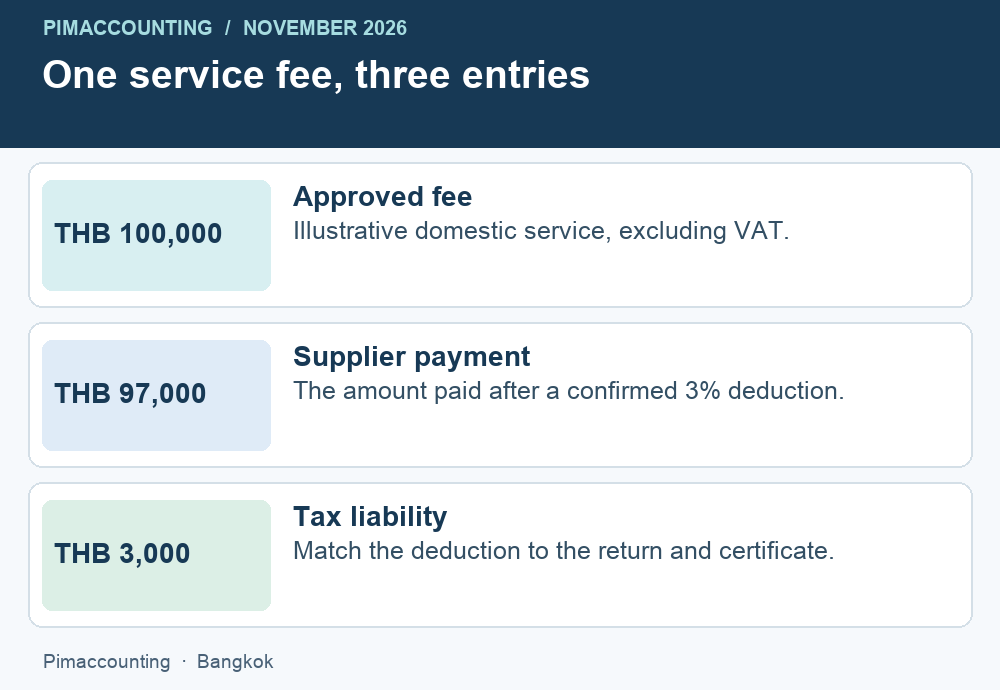
Suppose an adviser has already confirmed that an illustrative domestic service fee of THB 100,000 is subject to three percent withholding on that base. Leave VAT out of this example so that you can see the cash movements clearly. The company settles THB 97,000 with the supplier and recognises THB 3,000 payable to the Revenue Department. The supplier account clears by THB 100,000. If the bookkeeper posts only the bank transfer as the cost, both the expense and the withholding liability will be understated.
Now change one fact. The cashier sends the full THB 100,000 because the bank payment template contains the gross amount. Moving THB 3,000 from expenses to a liability does not recover cash from the supplier or settle the company’s reporting obligations. Record the exception, retain the payment confirmation and ask the adviser and supplier to agree the appropriate treatment. Do not quietly alter the invoice or issue a certificate that describes a deduction that did not occur as stated.
Classify the recipient before choosing the form
Prepare a worksheet with the supplier’s legal name, tax identification number, branch, invoice number, description of the work, payment date, amount and proposed form. Read the purchase order when “services” is the only description on the invoice. Rental, professional work, goods and mixed arrangements can require different analysis. Payments to individuals and payments to entities outside Thailand merit separate review. P.N.D.53 is not a catch-all form for every outgoing payment. A bank beneficiary name is particularly unreliable when an employee has paid a contractor and later claims reimbursement.
For partial payments, keep a running balance against the original bill. For batched transfers, retain the allocation file as well as the bank’s total. Give credit notes their own reference rather than overwriting the original invoice amount. These small habits matter when a supplier calls months later to ask why the value on its withholding certificate differs from its sales ledger. A row that links both the transfer and the invoice is much easier to defend than a monthly spreadsheet with no transaction references.
Separate filing, payment and the supplier’s certificate
Assign one person to prepare the return and another to review the total against the withholding liability. Agree who is authorised to approve the electronic payment and whether that person will be available before the cutoff. After submission, save the acknowledgement, check that the payment actually cleared and reconcile the remaining liability. A draft return, an accepted submission and a successful bank debit are different pieces of evidence. Put all three in the same monthly folder when they are applicable.
Before closing October, select a certificate from the file and read it as the supplier would. Does it identify the correct legal entity and branch? Can the supplier match the amount to a specific payment? Is there a contact who can explain a difference? Log outstanding certificates separately from outstanding tax payments. If an error surfaces after submission, preserve the original filing and the corrected calculation and have the appropriate additional filing or correction reviewed. Overwriting the original file makes a future reconciliation harder for both parties.
What to send us this month
A useful starting pack contains your payment register, a redacted bank extract, a sample invoice, the prior return and a list of disputed items. In the first enquiry, describe the number of payments, whether you pay individuals or overseas vendors and which filing channel you use. Keep personal identifiers and unredacted banking records out of the contact form. Pimaccounting can then discuss the scope of a withholding tax review or ongoing bookkeeping support in Bangkok. Tell us which October payments are holding up your return.